



Or listen on your favourite podcast app
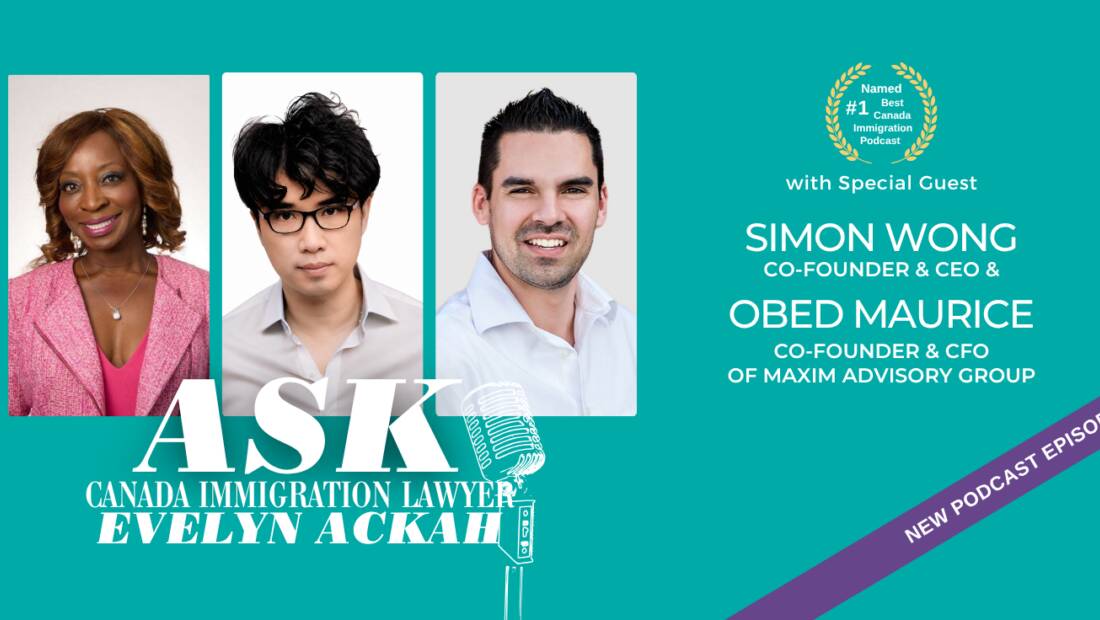
In this episode of the Ask Canada Immigration Lawyer Evelyn Ackah podcast, Evelyn speaks with Obed Maurice and Simon Wong of Maxim Advisory Group about financial planning, wealth management and what it really takes to build lasting financial security.
Evelyn, Obed and Simon talk about why a strong income does not always mean someone is building real wealth. They discuss the importance of looking at the full picture, including taxes, investments, insurance, retirement, estate planning and the future of a business, rather than making each decision separately.
The conversation also goes beyond the numbers. They talk about what retirement can look like emotionally and personally, why business owners need to build wealth outside of their companies and how families can prepare the next generation for an inheritance through honest conversations and financial education.
Whether you are a business owner, entrepreneur, professional or someone thinking more seriously about your financial future, this episode offers practical insight into planning with more purpose. Having the right people around you and a clear long-term strategy can make it easier to protect what you have built and make confident decisions about what comes next.
Links to Find Obed Maurice and Simon Wong:
LinkedIn: Simon Wong | Obed Maurice
Website: https://maximadvisorygroup.com
Need immigration help? Book An Initial Call With Our Client Engagement Coordinator
Here are the key points from Evelyn Ackah’s podcast with Obed Maurice and Simon Wong:
How Obed and Simon Entered Financial Planning
- Obed and Simon share how their careers developed through accounting, tax and financial advisory work.
- They explain that clients often need more than help with one tax issue or financial product.
- Their work focuses on helping clients understand the full picture and make decisions that support their long-term goals.
Building a Financial Master Plan
- The conversation explores how Maxim Advisory Group creates a clear financial plan for each client.
- The plan can include taxes, investments, insurance, retirement, estate planning and business succession.
- Obed and Simon explain that clients also need practical steps to put the plan into action.
A High Income Does Not Always Create Wealth
- Evelyn, Obed and Simon discuss why people with strong incomes can still feel financially insecure.
- Earning more money does not automatically lead to savings, investments or long-term wealth.
- Building wealth requires learning how to earn, keep, protect and transfer money over time.
Why Financial Decisions Are Connected
- Tax, retirement, investment, insurance and estate decisions should not be made separately.
- A decision in one area can affect several other parts of a person’s financial life.
- The episode highlights the importance of having accountants, lawyers and financial professionals working together.
Building Wealth Inside and Outside a Business
- Business owners often receive strong returns by reinvesting in their companies.
- However, relying on one business for an entire financial future can create risk.
- Obed and Simon discuss the importance of building personal and corporate assets outside the operating business.
Preparing a Business for the Future
- Business owners should think about succession before they are ready to sell or step away.
- Strong systems, delegation and the right team can help a company operate without relying entirely on the founder.
- Planning early can make a future transition smoother and may increase the value of the business.
Insurance and Risk Management
- Insurance is discussed as an important part of protecting a family, business and financial plan.
- Some events may be unlikely, but the financial consequences can be serious.
- Managing risk can be just as important as increasing returns or reducing taxes.
Rethinking Retirement Planning
- Many people begin by asking how much money they need to retire.
- Obed and Simon explain that the better question is how someone wants to live during retirement.
- Spending, inflation, investment returns, longevity and lifestyle all affect the amount needed.
The Personal Side of Retirement
- Being financially ready does not always mean someone is emotionally ready to retire.
- Evelyn, Obed and Simon discuss identity, routine, relationships and purpose after full-time work.
- Mentoring, teaching, working part-time or staying involved in the community can help create a more meaningful retirement.
Preparing the Next Generation for Wealth
- Successful wealth transfer involves more than leaving behind money or property.
- Families should discuss expectations, responsibility and financial values before an inheritance is received.
- Financial education and open communication can help the next generation manage wealth more responsibly.
Choosing the Right Financial Adviser
- The episode explains what clients can expect when they first meet with a financial adviser.
- The process begins with understanding the client’s goals, concerns and current financial situation.
- Obed and Simon emphasize the importance of finding the right mutual fit instead of using the same approach for everyone.
Final Takeaway
- Financial planning is not only about investments, taxes or reaching a specific number.
- It is about understanding what matters, bringing the right professionals together and making thoughtful decisions over time.
- A clear plan can help business owners, professionals and families protect what they have built and prepare for what comes next.
Need immigration help? Book An Initial Call With Our Client Engagement Coordinator
About Calgary Immigration Lawyer Evelyn Ackah
Evelyn Ackah is the Founder and Managing Lawyer at Ackah Business Immigration Law. With offices in Calgary, Toronto and Vancouver, we work with individuals and business owners from all over the world who want to cross borders seamlessly. For more information on immigration to Canada or the United States, reach out to Evelyn at Ackah Business Immigration Law today by calling (403) 452-9515 or emailing Evelyn directly at contact@ackahlaw.com.
The Ask Canada Immigration Lawyer Evelyn Ackah podcast, hosted by Calgary Immigration Lawyer Evelyn Ackah, was named as one of the Top 60 Podcasts on Immigration on the web by Feedspot.
00:00:03 | Hi, everyone. Evelyn Ackah here, and thank you for joining me on the Ask Canada Immigration Lawyer podcast.
00:00:13 | Today, I have the pleasure of welcoming two colleagues and friends to talk about financial planning, wealth management and the needs of business owners.
00:00:28 | My guests are Obed Maurice and Simon Wong from Maxim Advisory Group.
00:00:39 | Obed is a principal at Maxim Advisory Group, an integrated financial-planning and wealth-management organization.
00:00:53 | Simon is Obed’s business partner and brings extensive experience in financial planning and advisory work.
00:01:07 | Together, they help business owners and high-net-worth individuals with practical tax, financial and wealth-planning strategies.
00:01:20 | This is an especially important conversation for entrepreneurs and for clients whose financial lives may also involve cross-border considerations.
00:01:35 | Before we get into the details, Obed, tell me how you moved into the financial-planning world.
00:01:47 | You began in accounting, and the broader planning work came later. What led to that change?
00:02:00 | I started in accounting, where the work often focuses heavily on tax and on the immediate numbers in front of the client.
00:02:12 | Over time, clients began asking much bigger questions. They wanted to know what came next, what their goals should be and whether they were making the right decisions.
00:02:25 | They were also asking about retirement, their businesses and how all the different parts of their financial lives fit together.
00:02:37 | That made me realize there was an opportunity to go beyond isolated accounting or tax work and help clients with a more complete plan.
00:02:44 | That makes a lot of sense. Simon, your path into this work was different.
00:02:54 | Tell us about your background and what drew you toward integrated financial planning.
00:03:14 | I was working with successful individuals and business owners who, on the surface, appeared to be doing very well.
00:03:27 | But when I sat down with them, many were asking the same questions: What happens to me? What happens to my family? What happens to my business?
00:03:43 | They often felt that they were making decisions without knowing whether those decisions were truly right for them.
00:03:57 | I realized that people did not necessarily need another product or another insurance policy. They needed clarity and a coordinated plan.
00:04:12 | My role became helping them bring tax, investments, insurance, business planning and their personal goals together in a way that made sense.
00:04:30 | When you describe your financial-planning process, it sounds a little like creating a blueprint.
00:04:42 | How do you begin building that integrated picture for a client?
00:04:54 | Many of the people we meet have a very fragmented advisory team. They may have different professionals giving advice in separate areas.
00:05:08 | We begin by creating what we call a blueprint or master plan that looks across all of those financial domains.
00:05:21 | We identify the client’s goals, the issues that need attention and the expertise required to address each part of the plan.
00:05:35 | That may involve technical work in tax, estate planning, insurance, investments, business planning or other areas.
00:05:47 | The important part is making sure the client understands the plan and that it can be executed step by step.
00:05:59 | Business owners have so many moving pieces to consider.
00:06:09 | There is accounting, tax strategy, wealth management, retirement planning, succession planning and risk management.
00:06:23 | Those areas are not always brought together, so the integrated approach you are describing is valuable.
00:06:41 | Every client relationship begins with a master plan and a strategy.
00:06:52 | It is a deliberate process. We look at where the client is today, what they want to accomplish and what could prevent them from getting there.
00:07:07 | We then build the advice and implementation around that reality rather than beginning with a product.
00:07:21 | The advice itself is at the core of the relationship, and we are proud of the planning process we have developed.
00:07:42 | One issue that surprises people is that a high income does not always mean a person is financially secure.
00:07:53 | Simon, why do some high-income earners still struggle financially, even when they have a successful business, a home and other visible signs of success?
00:08:08 | One of the biggest misconceptions is that a high income automatically creates wealth.
00:08:19 | As income rises, spending and lifestyle can rise with it. Promotions or business growth do not necessarily change the person’s underlying financial habits.
00:08:34 | Income creates the opportunity to build wealth, but it must be consistently converted into assets.
00:08:46 | Earning money, keeping it, protecting it and eventually transferring it are different skills.
00:09:00 | A person can be very successful at earning income without having developed the other parts of that process.
00:09:14 | Financial insecurity exists at many income levels.
00:09:23 | Someone can earn a professional income and still feel as though they are living paycheque to paycheque.
00:09:34 | We see it among physicians, other professionals, business owners and people earning more modest incomes.
00:09:44 | The habits and structure around the money matter just as much as the amount coming in.
00:09:51 | That is such an important point. A higher income alone does not correct weak financial habits.
00:10:04 | When someone comes to Maxim Advisory Group, what does your process look like?
00:10:15 | How do you make sure you are looking at everything the client needs rather than only one part of the picture?
00:10:32 | Most professional advice is naturally delivered in separate areas.
00:10:41 | A lawyer focuses on legal issues, an accountant focuses on tax, and an investment adviser focuses on investments.
00:10:54 | But financial decisions do not happen in isolation.
00:11:02 | Tax decisions affect retirement. Retirement decisions affect investment and insurance choices, and those decisions can affect an estate plan.
00:11:16 | Our role is to make sure those pieces are connected and coordinated around the client’s goals.
00:11:26 | Do you have all of those professionals in-house, or do you also work with external partners?
00:11:46 | We have certain capabilities within the firm, and we also work closely with external professionals and trusted partners.
00:12:00 | Depending on the client, that team may include accountants, lawyers, insurance advisers, investment professionals and other specialists.
00:12:14 | Cross-border clients may need additional expertise because their tax, legal and financial circumstances can involve more than one country.
00:12:28 | Part of our planning process is determining who needs to be on the client’s team and when each professional should be involved.
00:12:42 | It is not enough to have good advisers. Their work must be coordinated so the recommendations support the same overall plan.
00:12:58 | Managing a family’s or a business owner’s full financial life can be a significant job, so we help organize that work and keep it moving forward.
00:13:17 | We also look for professionals who can understand the broader context rather than treating each issue as completely separate.
00:13:34 | That coordinated team is an important part of helping clients execute the plan successfully.
00:13:49 | I think that is a very strong offering, especially for entrepreneurs.
00:13:59 | Business owners often become deeply invested in their companies, both financially and personally.
00:14:10 | Simon, how should a business owner balance reinvesting in the company with building personal wealth outside the business?
00:14:28 | The business may be performing well and may offer strong returns, but it cannot be the only part of the owner’s future.
00:14:53 | This is one of the most common conversations we have with business owners.
00:15:02 | In many cases, the business is the highest-returning investment available to the owner, so continuing to invest in it can make sense.
00:15:16 | At the same time, the owner needs to build assets outside the operating business.
00:15:28 | That might involve corporate investments, holding-company assets or personal investments, depending on the client’s circumstances and goals.
00:15:42 | The goal is not to make the owner’s entire future depend on one company.
00:15:53 | A bad year, a major disruption or something happening to the owner can expose the risk of having everything concentrated in the business.
00:15:54 | That also connects directly to succession planning.
00:16:02 | What should an owner be doing now to make the business more resilient and ready for a future transition?
00:16:12 | There are technical reasons to prepare a succession plan, but there is also a very practical reason.
00:16:24 | A strong business should have systems and processes that allow it to operate without depending completely on the owner.
00:16:37 | That means hiring the right people, delegating properly and making sure the business is adequately funded.
00:16:50 | Even when an owner is not planning to sell immediately, running the company as though it needs to be sale-ready can improve the business.
00:17:03 | Succession is rarely something that should begin at the last minute. Owners may need five or ten years to prepare properly.
00:17:10 | The more the business can function without the owner, the easier it can become to manage and the more options the owner may have.
00:17:23 | That brings us to insurance and risk management.
00:17:34 | Simon, why is insurance such an important part of an overall financial plan for a family or a business owner?
00:17:49 | Financial planning is not only about maximizing returns or reducing taxes.
00:17:59 | Protecting against risk can be equally important, even when the event being insured against is unlikely.
00:18:10 | The probability may be low, but the financial consequences of death, disability or another major disruption can be enormous.
00:18:24 | An unexpected event can affect a spouse, children, business partners, employees and the continued operation of the company.
00:18:38 | Exactly. It is not something people should leave until there is already a problem.
00:18:47 | Insurance is one of the tools that can transfer that risk and protect the rest of the plan.
00:18:57 | Let us talk about retirement.
00:19:05 | People often ask, “How much money do I need to retire?”
00:19:14 | Is there a magic number, or is that the wrong way to begin the conversation?
00:19:28 | Retirement can also look different for every person. Some may stop working completely, while others may work part-time, take on partners or spend more time on personal interests.
00:19:40 | The question is usually focused on the wrong metric.
00:19:49 | Retirement is not simply about reaching one universal dollar amount. It is about whether the client’s assets can support the life they want.
00:20:02 | We have seen people retire comfortably with less than a million dollars because their spending needs are modest.
00:20:14 | Another client may need one hundred thousand dollars or more each year to maintain the lifestyle they want.
00:20:27 | The calculation has to account for spending, inflation, taxes, investment returns and longevity.
00:20:39 | Once those assumptions are understood, we can determine whether the plan is financially sustainable.
00:20:45 | People are also living longer, which can change the way they think about retirement and how long their money needs to last.
00:21:04 | There can be a good technical answer, but only after we understand the client’s actual goals.
00:21:15 | Someone may have sold a business and have significant assets, yet still ask whether retirement is possible.
00:21:27 | Another person may want to continue spending five hundred thousand or eight hundred thousand dollars a year, which creates a completely different calculation.
00:21:43 | We can build the budget and model the numbers, but the deeper questions are: What do you want to do with your life? What are your goals? What will your days look like?
00:22:00 | Retirement planning is also a psychological exercise.
00:22:11 | Clients need to become clear about what they want life to look like after leaving or selling a practice or business.
00:22:27 | Being financially ready does not necessarily mean a person is mentally or emotionally ready to retire.
00:22:42 | I have seen people retire earlier than expected and then realize they were not prepared for the change in identity, routine and purpose.
00:22:55 | It is not only a financial decision. It affects relationships and the way people spend their time every day.
00:23:12 | Exactly. A couple may suddenly be spending much more time together than they ever did while one or both people were working.
00:23:27 | A successful retirement plan should consider purpose, engagement and the activities that will keep someone connected.
00:23:41 | That might include mentoring the next generation, teaching, practising part-time or continuing to contribute in a different way.
00:23:56 | Staying mentally active, socially engaged and connected to important relationships can be just as important as having enough money.
00:24:15 | The strongest retirement plans address both the financial side and the life the person wants to build afterward.
00:24:32 | Simon, what are your thoughts on that?
00:24:35 | I agree completely. The life-planning side of retirement is essential.
00:24:47 | Let us move to passing wealth to the next generation.
00:24:56 | I have seen situations where a transfer was handled very well and others where it created significant difficulty for a family.
00:25:08 | Simon, what makes an intergenerational wealth transfer successful?
00:25:20 | Successful wealth transfer begins long before an inheritance occurs.
00:25:30 | Families need to communicate and prepare the people who will eventually receive or manage the assets.
00:25:42 | The conversation should include the family’s values, expectations and the responsibilities that come with the wealth.
00:25:54 | Education and communication can reduce confusion and conflict when the transfer eventually happens.
00:26:10 | That is a great answer. Education is such an important part of preserving a legacy across generations.
00:26:21 | Obed, how do you help families build financial literacy and begin those conversations before the money changes hands?
00:26:39 | Financial education can begin when children are young, using age-appropriate conversations about what money is and how it should be used.
00:26:55 | Many families simply do not talk about money, and that silence can create problems later.
00:27:08 | Money should not cause harm. People need the knowledge and values required to handle it responsibly.
00:27:22 | Larger estates can also involve greater legal, tax and family complexity, so the plan needs to address more than the transfer of the assets themselves.
00:27:38 | Families should think about the knowledge, decision-making skills and principles they want to pass on.
00:27:53 | The most valuable legacy may include education and values, not only money.
00:28:10 | For someone who wants to learn more about Maxim Advisory Group, what is the best way to reach you?
00:28:20 | And what should a prospective client expect when they first contact the firm?
00:28:38 | People can begin by contacting us through the firm’s website or by calling the office.
00:28:49 | The first step is usually a conversation so we can understand the person’s goals, concerns and current circumstances.
00:29:01 | We explain how our process works, what the fees look like and what the relationship would involve.
00:29:13 | We also determine whether we are actually in a position to help and whether the relationship is a good fit for both sides.
00:29:25 | Is your approach to accept anyone who comes through the door, or are you deliberate about the types of clients you work with?
00:29:41 | What does an ideal client relationship look like for Maxim Advisory Group?
00:30:08 | It has to be a mutual fit.
00:30:15 | We are deliberate about the clients we serve because the right client can receive much greater value from the way we work.
00:30:28 | We are not trying to provide a cookie-cutter or one-time service.
00:30:39 | We want to build long-term relationships with people who value integrated planning, collaboration and ongoing advice.
00:30:51 | We designed the firm around those relationships and around the kind of work we believe creates the best outcomes.
00:30:57 | I think the values behind a business matter so much, especially when people are trusting advisers with important decisions about their families and their future.
00:31:12 | I am excited about what you are building and look forward to continuing to work together.
00:31:24 | Maxim Advisory Group is also a trusted partner for clients who need coordinated financial guidance alongside cross-border work in Canada and the United States.
00:31:40 | Thank you both for sharing your expertise today. Listeners can look for Maxim Advisory Group to learn more and connect with the team.
00:31:54 | Thank you to everyone who joined us. I look forward to speaking with you again on the next episode of the Ask Canada Immigration Lawyer podcast.
00:32:05 | Thank you. It was a pleasure.