



Or listen on your favourite podcast app
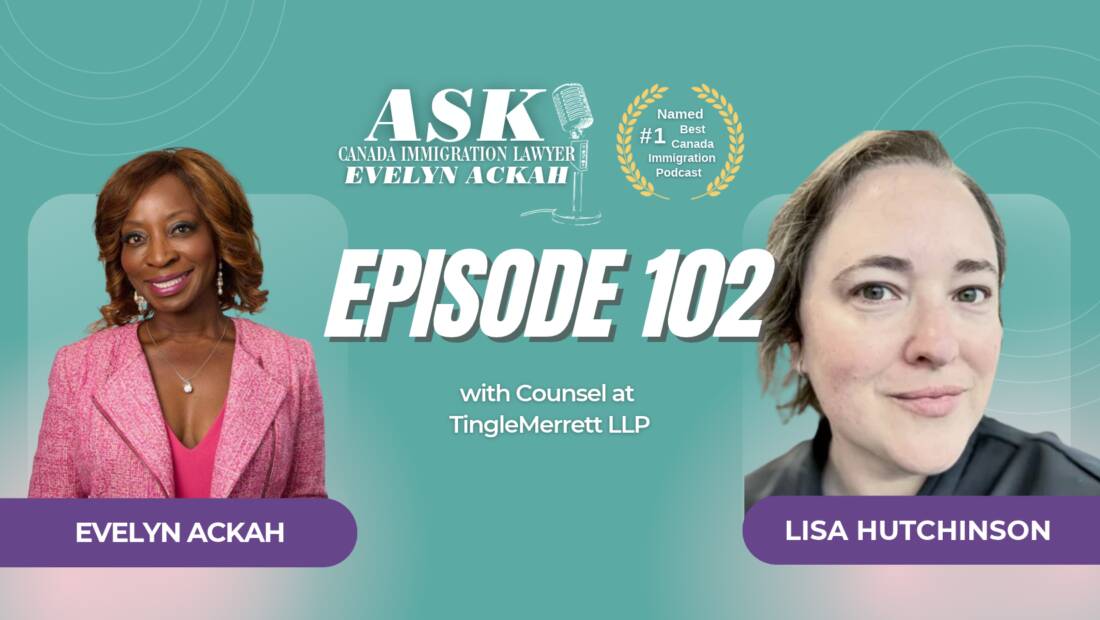
In this episode of the Ask Canada Immigration Lawyer Evelyn Ackah podcast, Evelyn speaks with Lisa Hutchinson, Counsel at Tingle Merrett LLP, about protecting your business, your brand and your family through thoughtful legal planning. Lisa shares how her background in computer science led her into law and shaped her practical approach to corporate matters, trademarks, wills and estates.
Evelyn and Lisa discuss common legal issues business owners overlook while focusing on growth, sales and operations. From checking a business name before launching a brand to reviewing commercial leases and planning for changes in ownership, Lisa explains how getting advice early can help prevent expensive problems. They also explore why business partners should discuss what happens if someone dies, becomes disabled, wants to leave or can no longer work with the other owners.
The conversation also examines how estate planning supports business continuity and protects the people who depend on you. Lisa discusses the importance of having someone with authority to keep a business operating if its owner becomes incapacitated or passes away. For newcomers with assets or estate documents outside Canada, she explains why reviewing the existing plan is essential to understanding whether it will work alongside their Canadian interests.
Whether you are starting a business, managing an established company or building a life in Canada, this episode offers practical insight into planning for both growth and the unexpected. Working with your legal, accounting and financial advisers before a problem arises can help protect what you have built and make difficult transitions easier for your family and your business.
Need immigration help? Book An Initial Call With Our Client Engagement Coordinator
How Lisa Entered the Legal Profession
- Lisa began her career in information technology after completing a computer science degree.
- Helping a friend prepare for the LSAT sparked her interest in law and showed her how her problem-solving skills could translate into a legal career.
- Her early experience with a general practitioner allowed her to explore different practice areas before developing her focus on corporate matters, trademarks, wills and estates.
Supporting Business Owners Through Different Stages
- Lisa explains how her practice areas grew from the needs of her small and medium-sized business clients.
- Business decisions often involve overlapping questions about ownership, contracts, branding and family planning.
- Building an ongoing relationship with advisers helps business owners address issues early and connect with other professionals when needed.
Protecting Your Brand Before Launching
- Lisa shares examples of entrepreneurs receiving cease-and-desist letters after investing significant time and money in a new brand.
- A trademark search can help identify potential conflicts before a business begins using a name or logo.
- Addressing brand protection early can reduce the risk of having to rebrand during an already demanding startup period.
Choosing a Business Structure That Supports Growth
- Lisa discusses how incorporating without considering future plans can create complications later.
- A structure that works at the beginning may not support changes in ownership, cash flow or business growth.
- Working with a lawyer and accountant early can help business owners avoid additional expense and difficult restructuring.
Understanding Contracts Before Committing
- Commercial leases, technology agreements and other contracts can create obligations that last for years.
- Lisa encourages business owners to consider termination provisions, automatic renewals and whether an agreement leaves room for growth.
- She emphasizes keeping legal spending proportionate to the value and potential consequences of the commitment.
Planning Before Bringing in a Business Partner
- Lisa recommends having difficult conversations before investing time and money in a business together.
- Partners should consider death, disability, divorce and the possibility that someone simply wants to leave.
- They should also discuss how decisions will be made if the relationship breaks down.
Why Partnership and Shareholder Agreements Matter
- Partnership agreements and unanimous shareholder agreements can establish a process for handling departures, disagreements and unexpected events.
- Lisa explains that discussing these situations early allows for more balanced conversations before emotions become heightened.
- Clear agreements can provide a way forward when owners cannot agree, while still allowing them to make different arrangements together.
How Wills Reflect Your Priorities
- Lisa describes a will as a document that tells the story of what matters to someone.
- Her approach combines clear instructions with enough flexibility to accommodate future changes.
- Collaboration with accountants and financial planners helps connect the family’s needs with the realities of the business.
Estate Planning for Newcomers to Canada
- Evelyn raises the importance of estate planning for work permit holders and new permanent residents who may already have documents or property abroad.
- Lisa explains why an existing foreign estate plan should be reviewed to understand how it works with Canadian assets and business interests.
- Depending on the circumstances, the solution may involve updating the existing plan or preparing coordinated wills for different jurisdictions.
Keeping a Business Operating After Death or Incapacity
- Lisa highlights the importance of ensuring someone has authority to give instructions, sign contracts and manage business payments.
- Without planning, a business may face delays while the family seeks the authority needed to keep operations moving.
- These interruptions can be especially difficult when loved ones depend on the business for income.
Planning for Business Succession
- The options following an owner’s death depend on the business, its staff and whether others can continue operating it.
- Some businesses may continue through family members or existing management, while others may need to sell assets and wind down.
- Legal and accounting advice can help owners prepare for these possibilities before an unexpected event occurs.
The Cost of Leaving Planning Too Late
- Lisa shares an example of a business whose owner died unexpectedly without estate planning.
- Keeping the business operating involved court orders, litigation, significant expense and lengthy delays.
- She explains that the time and cost of resolving these situations often depend on the planning completed beforehand.
Staying Connected With Your Advisers
- Lisa encourages business owners to keep their lawyers and accountants informed about changes and future plans.
- Regular conversations can help identify issues before major decisions are made.
- Evelyn and Lisa also discuss reviewing estate documents periodically and after important life changes.
Final Takeaway
- Protecting a business involves planning for its brand, contracts, ownership and future leadership.
- Estate planning helps connect those business arrangements with the needs of the owner’s family.
- Seeking advice early can help preserve options, reduce avoidable costs and make difficult transitions easier to manage.
Need immigration help? Book An Initial Call With Our Client Engagement Coordinator
About Calgary Immigration Lawyer Evelyn Ackah
Evelyn Ackah is the Founder and Managing Lawyer at Ackah Business Immigration Law. With offices in Calgary, Toronto and Vancouver, we work with individuals and business owners from all over the world who want to cross borders seamlessly. For more information on immigration to Canada or the United States, reach out to Evelyn at Ackah Business Immigration Law today by calling (403) 452-9515 or emailing Evelyn directly at contact@ackahlaw.com.
The Ask Canada Immigration Lawyer Evelyn Ackah podcast, hosted by Calgary Immigration Lawyer Evelyn Ackah, was named as one of the Top 60 Podcasts on Immigration on the web by Feedspot.
00:00 Hi, everyone.
00:01 Welcome to the Ask Canada Immigration Lawyer podcast.
00:04 I'm Evelyn Ackah.
00:05 And today I have the distinct pleasure of having my friend and colleague, Lisa Hutchinson, join me.
00:11 Hi, Lisa.
00:12 Hello.
00:15 I'm so excited you're here as we're focusing on Wills and estates and all things in your [unclear], in your area of expertise.
00:23 And before we start, I wanted to give an introduction.
00:26 So Lisa was an entrepreneur on her own before, and she's now working as counsel at...
00:33 TingleMerrett LLP.
00:35 They are a respected Calgary based law firm known for providing strategic legal advice to businesses, organizations, and individuals.
00:44 And she has a legal career built on professionalism, practical problem solving, and client advocacy.
00:51 Lisa focuses most of her work in the areas of wills and estates.
00:56 Corporate commercial as well as trademarks.
00:59 So she has a really broad business background.
01:02 So I'm thrilled to have you with us today, Lisa.
01:05 Thank you so much for joining me on my podcast.
01:08 Thank you so much for the invitation.
01:09 It's just wonderful to be here with you.
01:11 It's a treat to have you.
01:13 So listen, I want to hear and our readers or listeners always want to know.
01:18 You know, how did you start in this field of law?
01:21 So do you want to give us like a little bit of an overview of your journey to law and where you are now?
01:27 For sure.
01:28 So I was always, you know, a pretty academic student where school was something that I did well at.
01:36 Strong in maths and sciences.
01:39 And you became a lawyer?
01:40 I know, it's funny how that happens, it's so true.
01:45 But yeah, eldest daughter, so I think very drawn to work where you can be of service to other people.
01:53 And so I started out working in IT, I did a computer science degree, logical problem solving.
02:00 And because I was drawn to service, you know, I worked in sort of a healthcare industry, where, you know, it was a grind, I was on call, so I'd get woken up in the middle of the night to solve IT problems.
02:13 And so the work itself was satisfying, but I would say not delightful.
02:18 So it was very appealing, the idea of going back to school.
02:20 And I actually was helping a girlfriend study for the LSAT because logical problem solving was a strength.
02:25 And it made me realize how aligned my skillset was.
02:28 So that kind of sent me down the path.
02:32 You know, a big part of it was watching someone who was close to me and who I respected say, you know, I'm going to do this.
02:38 And I thought, well, maybe I could do that too then, right?
02:41 Seeing people do the things, it's so important.
02:44 So yeah.
02:45 That's so great.
02:47 And so when you started law, did you, when you finished law school, you went to the Saskatchewan School of Law, is that right?
02:53 Yeah.
02:53 University of Saskatchewan.
02:55 And I went to UC from undergrad, went to University of Saskatchewan for law.
02:59 So when you were finishing law school, what did you think you'd be practicing?
03:03 What kind of law?
03:05 You know, I wasn't sure.
03:08 I did in law really...
03:11 Like the intellectual property classes.
03:14 So those I did find very appealing.
03:17 I wrote my major paper in my intellectual property class where I wrote about the idea of property in massive multiplayer online gaming.
03:26 So I found a real intersection there between legal concepts that were being forced to evolve and my technical background.
03:36 So that I found to be quite exciting.
03:39 I was pretty sure I didn't want to do criminal law.
03:41 I found it really challenging.
03:42 Those are tough cases to read and thank goodness people want to do that work.
03:47 But it was, that's a tough area.
03:49 So I wasn't sure though.
03:50 So I did an article with a general practitioner where he did a lot of different things.
03:57 He did criminal, he did civil litigation, he did real estate, and I got a A chance to taste a lot of them and so it was good in articles to know that yes criminal law definitely wasn't for me.
04:10 I think the civil litigation part I didn't hate and I think civil litigation really does teach you how to be a lawyer down in the trenches and is a good way to start your career off only because you really do get a good foundation.
04:23 So that I found quite helpful and then the rest sort of you know as you practice you sort of do I think naturally lean towards certain areas of the law, certain types of practice and that Certainly happened for me.
04:34 That's so great.
04:36 I mean, when I met you, Lisa, you had joined a firm and you were doing the corporate work as well as the trademarks work, right?
04:45 So, and of course then the Wills and Estates came too.
04:49 And so I just love that you were able to provide that kind of support for clients, the business side, the trademark side, and then, hey, let's take care of your estate as well and your family.
05:00 How did that?
05:02 They all kind of work together is what I would say.
05:04 So most of my clients now are small or medium sized business owners.
05:10 And when you're running a business, You know, there's lots of different times when you are going to need a good team behind you, including a lawyer.
05:19 And so the type of relationship that we try to build with our clients is to say, if you have a question, come to us first, because sometimes it's in our wheelhouse and then we can kind of get ahead of things.
05:31 And that ultimately results in problem solving, being less expensive, and you're able to be a little more strategic instead of reactive.
05:41 But if it's not in our wheelhouse, like we're pretty connected to a lot of other professionals.
05:45 And if you don't already have someone on your team who can help you with whatever is on the table, we can usually connect you with the right person who can help you take that to the next step or level.
05:59 I would say a lot of the practice areas grew out of clients coming to us first.
06:05 It helps you develop expertise in the areas that your clients need you to have expertise in.
06:14 But also, there's this idea where I know so much about so many of our clients to send them to a different practitioner in certain areas.
06:23 You know that practitioner wouldn't have the knowledge that allows them to provide a very nuanced approach and practical approach to certain things.
06:30 So, I think that's the big thing that has led to where we've developed our areas of practice and that's really knowing our clients, listening to our clients.
06:40 That's so cool, Lisa.
06:42 So, like many business owners are focused on growth.
06:45 sales and operations.
06:47 What are some of the legal issues they often overlook until it becomes a problem?
06:51 What are you seeing most?
06:53 Yeah, so I would say brand protection for sure.
06:59 People work so hard on those things that you mentioned.
07:02 Like I see people, blood, sweat and tears, you know, like it is a labour of love most entrepreneur.
07:11 And the branding that goes behind it really does become this symbol of the goodwill in your business.
07:17 And I have had, it happened on more than one occasion where somebody launches their venture into the world.
07:25 It's a wonderful thing that they're offering and they end up getting a cease and desist letter that's really mean and really scary.
07:34 Usually from a big shot lawyer in Toronto, where they're being told that somebody already has this as a registered trademark and they need to stop and, you know, or else many scary things will happen.
07:47 Many scary things will happen.
07:48 Yeah.
07:49 And, you know, it's so heartbreaking.
07:51 You know, again, entrepreneurs are very resilient and pivoting is sort of one of those tools that you need in the Batman utility belt.
07:59 Like you need that at all times.
08:01 But It especially at the beginning of the venture when.
08:06 There's so much work in launching and when there's so much expense in launching, It's a terrible thing to be told that you then have to pivot and instead of making it be on your own timeline.
08:17 Yeah.
08:17 So yeah, so I would say that is one thing for sure.
08:20 You know, the kinds of things we can support people with as a trademark agent.
08:24 What we do is we can do searches to make sure that there's nothing on the trademarks register that would prevent you from being able to use a specific wordmark or logo, that kind of thing.
08:34 That can be really smart to do.
08:36 And again, it's another cost when you're starting up.
08:39 And I know that can be really hard in terms of cash flow management for small business.
08:43 I know it.
08:44 But you know, you can take you can be strategic in the way that you approach these things.
08:48 So do the search first, make sure that as you develop your brand, you're not running into trouble.
08:54 And then you can choose your timeline for the expense of registering that trademark if you want to do that eventually.
08:59 Because as you use your trademark in the marketplace, you are gaining common law trademark rights in that brand.
09:05 Which allows you to prevent people from passing themselves off as you within the geographic area where you've made your mark known.
09:14 You know, registering it kind of takes you to the next level where you get access to more remedies and you get Canada-wide protection.
09:20 But using your trademark isn't nothing like that's the first step.
09:24 But before you use your trademark, make sure that you're not going to get a mean letter from a big shot lawyer in Toronto.
09:30 Oh my God, that would be a nightmare.
09:32 It's scary.
09:34 You know, it's very scary.
09:35 I can imagine.
09:36 Oh my goodness.
09:38 So what is one mistake that...
09:39 you see that entrepreneurs make early on that could be avoided if they'd come to you first?
09:44 So beyond the trademark, you know, like how they set up the business, what business format they might choose to set up with structure.
09:52 I think that what I would label, I would say it's the theme of being reactive.
09:58 So I would say every step that you take in your business journey, you want the expense that you incur to support as many paths forward as possible.
10:11 So working smarter, not harder, that kind of thing.
10:13 You don't want to have to unwind something.
10:14 You want to take a step that lets you keep taking forward momentum steps.
10:20 So where we see trouble with a lot of clients is where, you know, if they walk into a registry to incorporate and the articles of incorporation that they get are not conducive to the type of growth that they have planned within their first or second year.
10:33 That requires, you know, consultations with accountants, consultations with lawyers, further expense to get everything sorted out and handled.
10:42 And sometimes those are expensive mistakes because you can't backdate everything, right?
10:48 So sometimes you kind of have to live within not ideal structure from the perspective of how cash is flowing in your company when that is the kind of thing that if you've got a good team on your side with respect to a good value-aligned accountant, value-aligned corporate lawyer, those are the kinds of things that we can prevent people from I'm getting too far down that path.
11:13 Again, just to make your legal dollars count, right?
11:16 Make them count.
11:17 So that is a huge one.
11:18 And I would say contracts as well as a huge one.
11:23 It's one of those things where you want it to be a proportional thing.
11:26 You know, to spend $2,000 to have me review a $100 contract is absurd.
11:31 Of course, that's silly.
11:33 But, you know, a lot of people will lock into a commercial lease, for example, which can be a $300,000 contract, for example.
11:39 And in a case like that, it's worth it to have your team look that over with you.
11:45 Those kinds of things.
11:46 Even contracts that you wouldn't think of, like I've seen clients get, you know, when they're busy in startup mode, they'll get a deal if they lock in a rate, for example, for like five years.
11:58 And while that seems so wonderful, and in some cases it is, businesses change a lot in their first five years.
12:07 And keeping in mind that you want to be strategic, you want to lock in deals, but you also don't want to hamstring yourself from growth and being able to pivot if your business kind of dictates that that's what needs to happen.
12:19 So not necessarily bad to lock in, but check those termination clauses, check to see if There's auto renewal clauses.
12:27 Those kinds of things can all be a little bit tricky when you're looking to set things up.
12:32 So a lawyer can help with that, but again, you know, keep legal advice proportional, especially startup.
12:37 The costs are many.
12:39 I can just imagine, you know, I mean, 16 years I've had my own firm and I just feel like just thinking back when you just started with nothing and you had this one little office that you, you know, shared office space and how things change and grow over the years, you know.
12:55 And sometimes we can't see, yeah, like how it's going to happen, COVID changed things so much for a lot of us in terms of just office space and technology and all kinds of things.
13:06 So you can't always foresee how these things will happen.
13:10 And especially a lot of contracts like...
13:13 Technology contracts are things that you're locking yourself into, you know, you don't know a year or three years like So to be always cautious about those long-term transactions that you'll have, if you sign something, how do you know you're going to still be using that a year from now or five years from now, right?
13:33 100%.
13:33 And that makes me think, just as you say that, even the idea of employees, like that's something that we can help guide clients through when they're taking those kinds of things on for the first time, where we can present clients with options like, you know, if you need help and support, maybe there's a way to do that without incurring the liability that comes along with being, you know, an employer of an employee, you know, there's different contractual relationships, there's different kinds of things that you can do, where it helps you manage some of those long-term liabilities, especially when, yeah, as a new business owner, like next year is going to look pretty different.
14:11 Yes, you never know.
14:14 So, you know, businesses change over time, Lisa, and you know, we're just talking about it.
14:18 And then sometimes people bring in partners.
14:20 They sell shares, they expand, they prepare to exit.
14:24 So what kind of legal planning should happen before these major transitions?
14:28 Let's say bringing on a new partner, like all the papering of that process because that can be very stressful.
14:35 Yeah, so I would say that the first good step is again to talk to each other.
14:44 I would say talk to each other first and really have some hard conversations about what What will happen in essentially two different scenarios or the two scenarios that we talk about.
14:54 The four D's, which is death, disability, divorce, and done.
14:59 So done being, you know, I...
15:03 We're friendly, nobody's fighting, but I just need an exit strategy.
15:07 And then the other scenario is the I hate your guts scenario.
15:10 So things are going badly.
15:12 We are not having a good time talking to each other and there's just nothing but conflict.
15:17 So the time for those conversations is before you enter into anything.
15:22 You know, there's no heightened emotion.
15:23 Nobody feels wrong.
15:25 There's no other interests that need protection.
15:27 It can be a real honest and equal negotiation at that point.
15:31 And I find the exercise of going through that.
15:33 So, you know, this is really setting people up for developing like a partnership agreement or a unanimous shareholders agreement if they're in the case of a corporation.
15:42 So these are kinds of questions that are answered in those documents.
15:47 And we always recommend that you have them.
15:51 You know, it's always a good idea.
15:52 We don't push too hard if the only people in the company are, you know, a husband or a wife, because there's a lot of law that supports how these things are going to happen within their relationship.
16:01 But anything outside of that, we're pretty, you know, we're big advocates of having those documents in place.
16:08 So the point is like, if you can get on the same page before you go down the road of putting time and effort and blood, sweat and tears into this business together, I find the clients that do that work, if a conflict arises, they already have the tools.
16:23 They know how this conflict is going to be solved.
16:26 And The conflict never gets to that fever pitch the same way.
16:29 There's always going to be outliers, but it really does help.
16:34 The great thing about something like those agreements is that they really do outline what happens if things go wrong and you can't agree.
16:41 The beautiful part is that you can always agree to whatever you want.
16:45 If you want to deviate from that agreement and everyone's in alignment with that, you can.
16:51 It doesn't prevent you from being able to agree to something else, but it protects you if you can't agree to anything else.
16:57 It's like planning for the divorce.
16:59 It's similar to a prenup before you get married is just the same thing.
17:05 When you have a partnership, it is a marriage of some sort essentially, right?
17:10 So planning for how do you extricate yourself from that I think is important.
17:15 Yeah.
17:15 And people really underestimate how often that does happen.
17:18 Like you may not have that intention when you're getting into business with someone.
17:21 Yeah.
17:22 But, you know, life happens.
17:24 You know, a spouse may get a job that they can't turn down across the country or something.
17:28 And that can affect things, you know, besides big, dramatic things that happen.
17:33 Little things happen in life where you're just like, I don't have the bandwidth for this anymore.
17:37 Absolutely.
17:38 So let's swing into talking about your wills and estates practice.
17:41 We've talked about trademarks, talked about corporate law.
17:44 How did you evolve into providing the Wills and Estates services for your clients or corporate clients?
17:51 Yeah, so I always, I started, I think my first will was when I was articling.
17:57 So it's sort of always been in the background of my practice.
18:00 I did.
18:02 Very well in Wills and Estates class in law school.
18:05 I never even did.
18:08 I loved it.
18:11 Writing a will to me is like computer programming, truly, if then else.
18:18 It is very logical.
18:20 It was very easy for me to kind of like start that if then else journey and make sure all the variables were wrapped up by the end of your clause.
18:27 And I think, you know, again, just Logical problem solving, it lends itself well.
18:33 So I've always really liked how Wills tell the story of what is important to someone.
18:41 I mean, this is where you are.
18:44 Telling the world, you know, this is what matters to me and it is a legacy thing.
18:49 And I think there's something very beautiful about that.
18:51 So we've always, I've always sort of done that.
18:55 And then as I, as more of my clientele became small and medium sized business, you know, you start collaborating more and more with the other team members that form a part of the team that supports these clients.
19:08 So accountants, financial planners, all these types of folks where You're able to have direct conversations about what becomes challenging from their perspective in the case of estate planning or what has, you know, become a problem for a client that they're dealing with in terms of an estate.
19:28 And so you're able to really bring all of that feedback into the documents that you do for your clients so that they're informed by all of this multidisciplinary experience and where You're able to then also ask your clients different questions and and think about you know from the business perspective what needs to be answered but also from the family perspective what does that mean right and how can we make sure that we build in place a structure that is robust enough to care for your loved ones which is what you ultimately want but has enough flexibility to deal with the fact that Death will happen at an unknown time.
20:05 We don't know what the tax laws are going to be.
20:07 We don't know what the state of your business is going to be, right?
20:10 So balance, like that's, that's always the theme.
20:14 I think in everything that I do is just kind of trying to hold that balance where you give enough structure to people that there's something meaningful there, but enough wiggle room that they're able to do what they have to do on a day-to-day basis and pivot and evolve.
20:28 That's so great.
20:29 I mean, obviously, you know, the majority of my work is immigration.
20:32 And one of the reasons that I wanted to have you on the podcast, too, is just to talk about the importance of wills and estate documents for immigrants, people that are here as work permit holders or even new permanent residents.
20:46 They still might have a will and estate plan back home in their home country, property back home.
20:51 But then why do they need one here in Canada?
20:56 What would be your The jurisdiction works essentially where your domiciles, where you live and where your assets are.
21:08 So one thing that we always talk to clients about is Making sure that whatever plan that they do have in place works here in Canada, especially if it's someone who's involved in a business.
21:22 And many people that come to Canada do start their own businesses, do buy into businesses that are existing.
21:28 It's a huge, huge thing that happens.
21:31 And one thing that you don't want to have happen is have a problem with your estate planning here in Canada that prevents the company from having, or your business from having An authority who can who can direct.
21:45 The business operations.
21:47 If something happens to you and your family's relying on that income, you need things to happen fast and you need things to flow.
21:54 You cannot have bills not get paid because nobody can sign a cheque, for example, like just as a really simple example.
22:02 And so if a foreign will were to come here, sometimes they don't meet all the formalities that we have here in Canada.
22:09 Sometimes they do.
22:10 There's an international will format, which is a side conversation.
22:15 It can be challenging and the best bet is going to be if you've got planning outside of Canada, what I like to do is tell my clients, show it to me.
22:23 I want to take a look at it.
22:24 I've got one right now from a client who's got American interest where, you know, show it to me.
22:29 I want to see the whole structure.
22:31 If this looks like the kind of thing where, you know, All of the assets that you have in Canada flow into that structure very easily.
22:38 We're not going to reinvent the wheel for you, but if there's a gap or if there's something that we can do better for you, ultimately for the purpose of making it easier on your loved ones, there's a way for us to be able to do That sometimes it's with redoing the whole kind of, you know, shebang if it's something that is appropriate.
23:01 Sometimes it's with having two wills that work together.
23:03 We've done that before jurisdictionally where we'll do a Canadian will only for your Canadian assets.
23:09 And that keeps the Canadian assets in Canada, deal with them in Canada, appropriate them in Canada, and it keeps things pretty clean.
23:16 So there's lots of different options and tools, but I would say from my perspective, especially supporting mostly business clients, the key piece is you do not want to run into that scenario where you have nobody within a business that can give instructions to a lawyer, for example, who can sign a check, who can sign a contract, who can keep that business flowing, especially if your loved ones rely on that income.
23:42 Yeah, I can imagine.
23:44 I just recently had a colleague and a friend of mine just very suddenly.
23:49 had a stroke and She had a child, a teenager on her own, you know, and running a law firm and she's a wills and estate lawyer.
23:59 So I know for sure that and they had to, you know, do the turn off.
24:04 All of that, brain dead, all of that and it was just so tragic and the only good thing I guess was knowing that for sure she had done everything right because that was her area of expertise was wills and estates and power of attorney and guardianship and you know all those things were taken care of for sure in addition to this immense loss at least knowing that those things were taken care of.
24:26 So it's just devastating when it happens.
24:28 But how do you think people can protect themselves or their businesses in terms of like succession planning?
24:34 If something like this happens, you know, what, what happens then?
24:38 And you just shut down the business or do you have a plan in place?
24:43 Yeah, it depends on the nature of the business, I would say.
24:45 So if it's the kind of business where without that person there, you know, there's nobody else sort of turning the wheel to Keep the cogs moving.
24:54 In a case like that, very often we will see families essentially shut that business down.
25:00 There are assets typically within the business though, that can be sold to colleagues, for example, like a client list or, you know, whatever may be.
25:08 In that, the nature of that business.
25:11 So there is work to be done before you kind of just shut the doors and, you know, selling assets within the company, again, will primarily operate to help the family because that's one money for the family then, right?
25:22 Yeah.
25:22 So there's things like that that can be done.
25:25 There's, you know, If it's the kind of business where the wheels can keep turning because there's staff and that kind of thing.
25:35 Again, we've seen it where sometimes kids are involved in the business, so it can be sort of, yeah, there's already a family element there.
25:43 And in a case like that, yeah, very often there's ways with accounting support to go ahead and You know, deal with the shares and make sure there's some good tax planning and that kind of stuff in terms of the succession.
25:58 Sometimes there's already a plan in place where a death or disability doesn't affect the structure or the corporation too much because you've done that work ahead of time.
26:07 So there's lots of things like that that the accounting and legal team can support people with, especially if it's a family business with adult children who are involved.
26:16 We've seen with some, we saw This was many years ago now, but we did see, you know, a pretty like a larger company that was quite busy and had like, you know, lots of employees and that kind of thing where the owner suddenly passed away unexpectedly, no estate planning.
26:35 And it was years and years and years of, you know, I don't know all the details of it, but there was some litigation involved.
26:45 There was some, you know, just Court orders required to keep the lights on and keep things moving and keep things happening and it was so expensive and it took so long.
26:58 And, you know, these were all the people involved were people who had pre-existing relationships and I think cared about each other quite a bit.
27:05 And, you know, it's sometimes there's no way to gain that corporate authority, for example, other than through those kinds of systems.
27:14 And it's pretty devastating.
27:15 So the point is just simply that There's always a path forward, you know, what that path looks like in terms of a timeline and expense really does depend on the work that was done before anything happens.
27:30 Yeah.
27:30 Yeah.
27:30 So you are the queen of do it in advance, do it right at the beginning, be collaborative, but be proactive as opposed to reactive.
27:40 I mean, that's what I know about how you practice, which is amazing.
27:45 It does.
27:46 And people really underestimate it.
27:47 And I would say always like the big theme to me is talk to your advisors, right?
27:53 Like for business clients in particular, like your accountant and your lawyer are very important to you.
27:59 And I would rather have a client call me like, I don't know, I don't.
28:04 I have to talk to clients every year, a lot of them, but like call me once a year and tell me what's happening.
28:08 Tell me what's happening in your business.
28:10 You know, tell me what you're planning on for the next five years.
28:13 I have one client in particular who is amazing at this.
28:17 I think they have like an MBA background and so they're well suited to have the skills to be able to just lay that out.
28:25 But I appreciate it so much because it helps me think like, have you thought about this?
28:29 Have you thought about this?
28:30 And they can kind of put it into their five year plan, right?
28:32 Like it may not be, if you're young and healthy, me trying to say to you like, oh, estate planning is so urgent.
28:38 You have to do it tomorrow.
28:39 I mean, it's obviously false, right?
28:42 But it is important and you cannot leave it for 10 years, right?
28:46 No, you cannot.
28:47 So work it into your plan, work it into the three year plan, you know, prepare for that expense.
28:53 Um, you know, it's not a giant expense in the realm of what you're going to pay a lawyer.
28:57 It's the best value here ever.
29:00 Truly.
29:01 And have a look at every few years or when any life changes, make sure nothing has changed, you know.
29:08 Yes.
29:08 We say every five years, take a look, make sure it says what you want it to say.
29:12 I really do write our documents to be good for as long as possible.
29:15 And it's not just because we want you to have good value for your money, which of course we do.
29:23 But it's also because I need to do that professionally.
29:26 That's the responsible thing to do.
29:27 If you were to suffer an event that affected your capacity, you could still live for a very long time while incapacitated and therefore be unable to update any of your documents.
29:38 So you need them to be very good for as long as possible.
29:41 Great reminder.
29:44 Well, listen, I want to thank you so much for joining me on the podcast and giving our clients and our listeners just a little taste of your level of expertise on the business, the trademarks and the wills and estates practice.
29:57 And that's why you're my go-to.
29:58 I love that you're an expert in all these areas because for small and medium businesses, having that, you know, one-stop shop as well as now that you're with Tingle Merrett, you can provide even Other services through your colleagues as counsel of the firm.
30:14 It's a great advantage and I'm just so grateful for you and your friendship all these years.
30:19 And I want to thank you for joining me on the podcast.
30:22 Thank you for having me and right back at you with everything.
30:25 Thank you, my friend.
30:27 You're the best.
30:28 You are.
30:30 Thank you, my dear.
30:32 We did it.
30:33 Yay!
30:34 30 minutes.
30:35 I want us to book.
30:36 Let's get something in the books when you can come up for air.
30:39 Now that I've let you have your time, I want to hear how it's going because there's a lot of things moving in my world.
30:46 So you just sent me some dates, like late July, August, if you're around, if you want to get together on a patio, I'd love to see you.
30:53 I would love that.
30:54 Okay, good.
30:55 Okay.
30:55 Take care.
30:56 Bye, honey.
30:57 Thank you so much.
30:58 Bye-bye.