



Or listen on your favourite podcast app
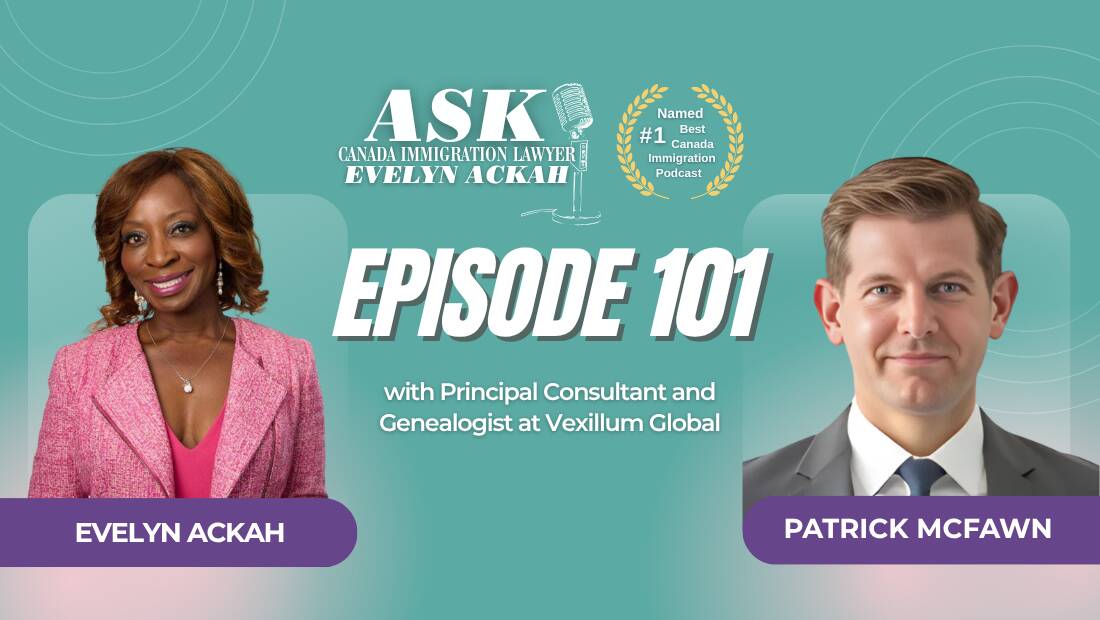
In this episode of the Ask Canada Immigration Lawyer Evelyn Ackah podcast, Evelyn speaks with Patrick McFawn, Principal Consultant and Genealogist at Vexillum Global, about citizenship by descent and the family records that can help establish a claim.
Patrick explains what citizenship by descent means in practice and why finding a Canadian ancestor is only the beginning. He and Evelyn discuss how birth, baptism, marriage, death and naturalization records can help trace a family line across generations, including when names or historical records do not match neatly.
The conversation also explores the difference between finding a record online and obtaining the documentation needed for an application. Patrick shares why some records require research in archives, while Evelyn discusses the legal work of connecting those records to a citizenship claim. They also talk about growing demand for Canadian citizenship by descent and the time it can take to gather documents.
Whether you are exploring your family history, wondering if you may have a claim to Canadian citizenship or thinking about future options for your children, this episode offers a practical look at where to begin. Understanding your family tree and preserving the records you find can be valuable, even before you know whether you qualify.
Links to Patrick McFawn:
LinkedIn: https://www.linkedin.com/in/mcfawn
Website: https://vexillumglobal.io
Need immigration help? Book An Initial Call With Our Client Engagement Coordinator
How Patrick Became a Genealogist
- Patrick’s interest in genealogy began with researching his own family history.
- He became particularly interested in immigration records and how they can reveal where families lived and moved across generations.
- That work grew into Vexillum Global, where he helps people research citizenship by descent.
What Citizenship by Descent Means
- Citizenship by descent involves tracing a claim through an ancestor who held citizenship.
- Patrick explains that having a Canadian ancestor is a starting point. An applicant also needs records that establish the ancestor’s status and connect each generation to the next.
- Patrick shares how his own family records helped him pursue Canadian citizenship.
Why Family History Websites Are Only a Starting Point
- Websites such as Ancestry and FamilySearch can help people discover records and share family trees.
- Some records have never been digitized or indexed, while others must be requested directly from an archive.
- A family tree alone does not provide all the documentation needed to support a citizenship claim.
The Records That Can Help Establish a Claim
- Birth, baptism, marriage and death records can help document the family line.
- A birth, baptism or naturalization record may also help establish an ancestor’s citizenship status.
- Patrick explains why marriage records can be useful: they provide another way to confirm names, parentage and relationships across generations.
Why Historical Records Can Be Complicated
- Recordkeeping varied across Canadian provinces and changed over time.
- Older records may have been maintained by religious institutions rather than civil authorities.
- Names can differ between birth and baptism records or across generations, making it important to show clearly that the records refer to the same person.
Gathering Documents Takes Time
- Patrick describes growing demand for historical records and longer response times from some archives.
- Access rules differ by archive, and some records require a certified copy or research beyond an online search.
- Evelyn and Patrick encourage listeners to begin gathering family documents early, even if they are still exploring their options.
Putting the Application Together
- Patrick distinguishes between believing you may be entitled to citizenship and documenting that claim for review.
- The records need to form a clear chain from the Canadian ancestor to the person applying.
- Evelyn and Patrick discuss how genealogical research and legal analysis work together to explain the claim and present the supporting documents.
Why People Are Exploring Canadian Citizenship
- Evelyn discusses interest from Americans who have discovered Canadian connections in their family history.
- For some, citizenship may offer future choices for themselves or their children, even if they have no immediate plans to move.
- Patrick notes that understanding and preserving family history has value beyond any citizenship application.
Citizenship by Descent Beyond Canada
- Patrick also discusses his work with citizenship by descent research involving other countries, including Ireland and Italy.
- He explains that each country has its own rules and that gathering records does not guarantee an outcome.
Final Takeaway
- A possible citizenship claim begins with family history, but it depends on the records that establish status and connect the generations.
- Online research can help identify a path; archives and historical documents may be needed to complete it.
- Preserving family records now can make it easier to explore opportunities for yourself and future generations.
Need immigration help? Book An Initial Call With Our Client Engagement Coordinator
About Calgary Immigration Lawyer Evelyn Ackah
Evelyn Ackah is the Founder and Managing Lawyer at Ackah Business Immigration Law. With offices in Calgary, Toronto and Vancouver, we work with individuals and business owners from all over the world who want to cross borders seamlessly. For more information on immigration to Canada or the United States, reach out to Evelyn at Ackah Business Immigration Law today by calling (403) 452-9515 or emailing Evelyn directly at contact@ackahlaw.com.
The Ask Canada Immigration Lawyer Evelyn Ackah podcast, hosted by Calgary Immigration Lawyer Evelyn Ackah, was named as one of the Top 60 Podcasts on Immigration on the web by Feedspot.
00:00 Hi, everyone.
00:01 This is Evelyn Ackah.
00:02 Thank you so much for joining me on the Ask Canada Immigration Lawyer podcast.
00:07 Today, we have the distinct pleasure of having my friend and colleague joining us, Patrick McFawn.
00:12 Hello, Patrick.
00:14 Hi, good to be with you.
00:16 Thanks so much for joining us.
00:17 I love your background.
00:18 Every time I see it, I'm like, it's so beautiful.
00:20 Where is that?
00:23 That's the Canadian Rockies.
00:25 That's what I thought.
00:26 It looks familiar.
00:28 It does, right where I am.
00:30 So let me tell you a little bit about Patrick.
00:32 Patrick is the principal consultant and genealogist at Vexillum Global, a genealogical research firm focused exclusively on citizenship by descent.
00:43 Through the work he does, Patrick helps individuals and families explore whether their ancestry may create a pathway to citizenship in another country, often by uncovering family records, tracing lineage across generations, and building the documentation needed for strong citizenship by descent application.
01:02 Welcome, Patrick.
01:03 Great to have you.
01:05 To give a little background to our listeners, we started working together this year around my clients and the need for their genealogy support.
01:18 And since we're lawyers and not genealogists, it was wonderful that we were able to connect and have you work with our clients to help them find their documentation.
01:28 And that's why I thought it'd be great to have you on the podcast to learn more about you, your journey, but also how you got into this really interesting area.
01:36 So Patrick, before we get into citizenship by descent, tell us a little bit about your background and how you got into this whole field.
01:44 Yeah, of course.
01:46 Genealogy was a passion of mine starting about 10 years ago.
01:52 One day, you know, you hear all of the family lore, right?
01:55 Oh, your grandparents did this, your great grandparents did this.
01:58 And suddenly I realized that we live in a world where you can find those records and reconstitute the story.
02:05 And there's a level of relevancy to history that I think underpins that.
02:12 And so I started doing it as a hobby, and I realized when I went back to that, I had a lot of colleagues who had a second citizenship, and they were not from the countries that those citizenships were from.
02:29 And I realized that most of them had obtained them through genealogical documentation, and that's something that I was passionate about.
02:36 So I dug into my own family tree, I dug into my friend's family tree, and I realized very quickly that it was something I thought was fantastic.
02:47 And so within the world of genealogy, you know, people specialized in different ways, and I tended to specialize in immigration history within the family tree.
02:56 And then from there, you know, suddenly, you know, the last five, six years, ever since COVID, people have been very interested in a second citizenship, and this fits right within that.
03:07 And, you know, it's something I care about and I believe in.
03:09 So it naturally turned into a business.
03:13 That's so fabulous that you turned that hobby into a business.
03:17 And tell us about your journey because you also now are a Canadian citizen as well as an American citizen, right?
03:23 How did that come about?
03:25 Yes.
03:27 So, you know, generally speaking, I would say that most citizenship by descent programs tend to be very, they tend to be restricted more so than expanded.
03:38 And so I was following the then court case in Canada that drove Bill C-3 that was then passed a couple years later after that court decision in 2025.
03:53 And so, you know, the funny part is that as a genealogist and just a document nerd generally, all of the documents required for this process were ones that I had in my own, my own archive, personal archives.
04:08 And so as soon as the document started, I walked over to my file cabinet and assembled it.
04:15 And so it is, you know, that is something I tell people, like there's value in genealogy as an option for the future too.
04:22 So it never hurts to have this stuff documented.
04:25 And, you know, I was able to use that for Canada.
04:28 That's great.
04:29 That is so great.
04:31 I find it interesting that, as you said, during COVID, more and more people seem to be interested in like Ancestry.com and all of those different websites.
04:39 Have you found that really helpful for your business in the sense that everybody's digging into their family lore and their, you know, their family genealogy?
04:49 And they probably think they all have everything they need because it's on Ancestry, but they don't realize that that's not the compelling or anchored documentation that they need.
04:58 How do you deal with that when everybody comes to you and they think they already know everything about their family?
05:04 You know, the funny thing is that when people come to me, they generally realize they've gotten to the limit of what an Ancestry or family search can provide.
05:12 Those are both very useful tools.
05:15 Yes.
05:17 And they make sharing someone's profile, you know, very useful and saves me a lot of time, saves them a lot of time.
05:25 But those are digitized documents that are then, you know, shared with those services.
05:31 And so they're very useful for searching, but most documents that ultimately people need are generally not indexed.
05:40 They may be, you know, they may sit on Ancestry, but, you know, they're image files.
05:44 You can't search them and, you know, you got to go.
05:47 They're one in 10,000 images and you got to reverse engineer how they were organized 150 years ago, right?
05:53 Or you know, more frequently, they're just not on those websites because they're protected.
05:59 They're very specific, you know, so you got to go to the website, you got to go to the website, you got to go to the website.
06:06 You got to go to the website.
06:06 You got to go to the website.
06:06 And those are archives all have their own rules for access and where that record lives is not really determinative based on Ancestry or family search.
06:16 Okay, interesting.
06:18 So just for our listeners, so the reason that things became busier for our long term on the citizenship side is because of the change and the passing of Bill C-3 and the fact that it became law in December of 2025, people who could not previously have qualified for Canadian citizenship by descent now qualified, likely if they had the right paperwork.
06:41 And so it's led to a big onslaught of people all wanting to claim citizenship, whether it's from 1867 or 1989, it really depends on, you know, all the way there.
06:52 So can I ask you, when you people hear the term citizenship by descent, what does it actually mean in practical terms?
06:58 Because they just, they're thinking, genealogy, I'm just going to claim, you know, descendancy, I'm just going to claim the status.
07:06 But what does citizenship by descent mean to you specifically in the work that you do?
07:10 Yeah, citizenship by descent means that you are claiming a status, a citizenship status that one of your ancestors had.
07:19 I used to do a lot more of this with Italian citizenship by descent before Italy restricted its citizenship by descent laws.
07:27 And when I tell people, when I told people that back in the day, they would say, well, how Italian do you have to be to claim this?
07:32 Like it's some fraction of like, I'm 50 percent.
07:35 And it's, you know, the answer is no, that's not relevant.
07:39 What's relevant is, do you have an ancestor grandparent, great-grandparent that had a citizenship status?
07:45 And that requires pulling the records that determined their citizenship status at that period in time.
07:52 And so as it relates to Canada, you have to get the documents that were issued, you know, that determine someone's citizenship status.
08:00 And more often than not, it's a birth certificate because or a baptism certificate because it is usually a country that that is what determined your citizenship status.
08:08 But sometimes, sometimes it's a naturalization record.
08:11 And finding a naturalization record from 1914 is not the easiest thing to do.
08:18 And also, you know, a lot of countries, they enact these laws, and they don't necessarily think about the documents that will then be required for it.
08:26 It's not a reverse engineered process.
08:28 And so suddenly, you have an archive or like, nobody cared about these documents five years ago.
08:32 And now we're getting 1000 requests for like, documents that, you know, a lot of people don't know how to organize, don't know the laws at the time.
08:41 And so it creates some confusion.
08:44 But at its core, what you're doing is you're getting documents that determine something in history, legally, and applying it to today.
08:52 So you know, when I tell clients when they come to me, and they think they have everything is we always want to have the first thing is that anchor document, I call it an anchor document, I don't know what you call it, but that original document or, you know, obviously notarized or certified copy, but that establishes birth, establishes citizenship, establishes baptism, recognition, plus maybe then a census record and then marriage certificates.
09:17 And so what is the idea?
09:19 Let's say we're going back three, four generations, in terms of what you would want to be able to find for your clients.
09:26 How would that start?
09:27 Because sometimes people think they need everything in addition to the birth certificate, but marriage and death and marriage and death and marriage and death and marriage and death.
09:35 What do you think would be the ideal three or four generations of evidentiary documentation that would satisfy, let's say, the Canadian government in a citizenship application?
09:45 Yeah, that's a great question.
09:46 I would say at its core, you're going to want birth, marriage, death for every generation.
09:53 Obviously, that is sometimes not possible, depending on how far back you go, because records are, you know, imperfect.
10:01 I would also say that you want the document that establishes the citizenship status of your ancestor.
10:08 That is like I call it the foundational document, but it is that anchor document.
10:13 It's generally a birth or baptism record.
10:17 You know, Canada is very different between each province and the records that they kept historically.
10:24 And on top of that, most, if you go far back enough, they're all religious records, because religious institutions were chartered with maintaining these documents, you know, 100 plus years ago.
10:36 And so, you know, whether or not your ancestor was Presbyterian or Catholic or that plays into it as well.
10:44 And so having those birth, marriage, death, you know, stack per generation is key.
10:51 Anything on top of that, that is issued by a Canadian institution, I think is like good contextual documentation, Canadian census records, anything that might suggest a name change.
11:03 And I'll add this here, because, you know, names in historic Canada can be a little bit unique, particularly because many 100 plus years ago, many families had to fill out a civic, particularly in Ontario, they had to fill out a civic registration for birth.
11:20 However, what they named their child, actually, they cared more about the baptism record.
11:24 So many times you'll find a birth certificate with an incorrect or a placeholder name, and then the real name is on the baptism record.
11:31 So you want both.
11:33 And then, you know, and then in French, Canada, the naming conventions are very, very different for a bunch of historical and religious reasons, which I'm happy to talk about.
11:42 But I bring all those up because sometimes you want to make sure that the naming of your ancestor is very clear in the documents, so that when someone is adjudicating your claim to citizenship, it's easy for them to understand this is the same person.
11:58 And this person is related to the person claiming the Canadian citizenship.
12:03 Okay, so let me ask you, why do you think why do we need marriage certificates?
12:06 Because this is one of those things that I'm doing when clients come to me.
12:09 And I'm always like, yes, we need the foundation documents.
12:12 And then we need the proof of, let's say birth, you know, this is your great, great, great grandparent, or whatever, and then how up the chain of birth certificates, let's say, and maybe death certificates, but especially birth, and then birth, and then birth, and then birth, why do we need marriage certificates as well, in your view, ideally, I mean, in a perfect world, what a marriage certificate communicates is parentage, right?
12:37 So let's say you're you're claiming through your great grandparent, your grandparent, their birth record has two parents on it.
12:45 I mean, that can be different nowadays.
12:47 But back then, it was two parents.
12:49 And so it's a way for them to check and say, this person's great grandparent, mother, great grandfather and great grandmother are in fact, related to this child, it basically acts as an additional data point to establish a parent-child relationship.
13:06 And, you know, there's also, there's this aspect in genealogy where you want multiple forms of confirming that this person is the person.
13:16 You know, and if you have someone with a very common name, like, particularly, let's say, like in the Atlantic provinces, there's a lot of common, like Scottish descent names, you know, we want to make sure John McDonald is in fact, the John McDonald on this person's parent, and the way you can establish that is through with an additional marriage record.
13:34 And so that, you know, it's not a 10 out of 10 needed, but it is a nice seven to eight out of 10 helps establish everything.
13:42 Okay, that makes perfect sense to me now.
13:45 Because I think you probably are seeing that it's taking longer to get documents from all the different authorities across Canada right now, because they're inundated.
13:56 What are you seeing in you know, how long are wait times and things like this?
14:00 Because people think now that I'm ready, I'll be able to just pick up the document in a week and go.
14:05 And it's taking longer for sure.
14:07 So how have you been?
14:09 What have you been seeing?
14:11 Yeah, so the wait times, the short version is they increase at an increasing rate.
14:18 The proof of just a process, assuming you have everything, the current processing time just got updated to 19 months, it was 17 months, a month ago, and two and a half months ago, it was 15 months.
14:34 I'm sorry, it was, yeah, it was 15, 15, 17, 19.
14:37 Yeah, before this law went into place.
14:41 And it was just the, you know, first generation limit, that processing time was around eight months.
14:46 So it's gone up by over 100% because of this law.
14:51 And then on the archives front, it really varies.
14:55 But I would say generally, it's a three to four month processing time for most requests.
15:03 Some archives have used the opportunity to hike fees like the Quebec archive.
15:09 Some have just been inundated.
15:11 And so they come up with a web form used to be able to email them.
15:16 And the response times have gone way down, right?
15:18 So you know, I went back and forth with the Quebec archives a couple years ago, because I was doing an unrelated research project unrelated to this, and they would write me back within the day.
15:32 And nowadays to get a response time is multiple business days.
15:35 So everything is going up and up and up.
15:40 There are some archives that allow in person visits.
15:43 And so I have, you know, subcontracted out specific on the ground research initiatives for people who don't want to wait the three to four months.
15:52 However, not every archive has that.
15:53 And sometimes they just say, you can connect this with us online or, or by phone, but you can't show up.
15:59 We don't have a walk in policy.
16:00 So it really varies.
16:02 But the short answer is everything is going up in terms of wait time.
16:07 And, you know, and even then, you know, if there's an archive that doesn't have digitized records, it gets even more complicated.
16:14 So, you know, as with everything, it pays to start yesterday.
16:17 Yeah, definitely.
16:19 I mean, one of the things I tell clients, you know, is obviously to work with you if they don't have the documents, but also is, is that this could change again, right?
16:28 And it's like, we've seen it with Italy and some other countries where it's more open door and then it becomes close, more and more narrow.
16:36 And so I'm wondering, what are your thoughts on this?
16:37 I mean, as an immigration lawyer for 26 years, I have some thoughts that maybe in a year or two or three, something will change again, because this is a bizarre, very wide open policy, which is great for people who want to claim it.
16:51 I have a lot of clients who want it just to have it.
16:53 And then of course, there are those that are like, we're ready to move as soon as we get it.
16:57 So there are different motivations for different people.
17:01 But what are your thoughts on this?
17:02 Do you think this is something that's going to be consistently, you know, across the board for the next three, five years?
17:08 Or will it change again?
17:10 I do think it will change at some point.
17:13 You know, the Italy example is good because I remember it changed in March 2025.
17:20 And I remember in September 2024, about six months before, I was getting feedback from several lawyers saying, everyone's dragging their feet.
17:30 You work with anyone at the consulate and they just didn't want to do it.
17:33 And I remember sitting there thinking, if you're working in the civil service in Italy, you don't want to deal with this and you're communicating that upward.
17:42 And so, you know, part of the reason why they made those changes was because radis for intake of those citizenship by descent claims was completely overwhelmed.
17:51 And I think we're kind of seeing that a little bit with Canada right off the bat.
17:57 I also think that this law was intended to provide some level of, you know, historic justice, a little bit of some...
18:06 Yes, the lost Canadians and all of that.
18:08 Yes.
18:09 And I don't think it necessarily counted for, like, on a look forward basis how many people would be motivated by this.
18:15 To obtain this, I also don't think people realize how big the world was in terms of Americans who would find this very compelling.
18:25 And so, you know, there will be an administrative regulation that comes down at some point in the future and says, here's the limit, right?
18:33 It could be, you know, it could be, you know, Canada Day 1867, it could be 1948 when Canadian citizenship was formally designated as opposed to British subjecthood.
18:46 So, you know, there's a lot of pieces to it.
18:48 But I do think that at some point there will be some level of constriction.
18:53 What form it takes, I don't know.
18:55 So, you know, as with everything it pays to get an application in Canada.
19:00 Absolutely.
19:00 I'm telling everybody the same thing because I don't know what's going to happen.
19:03 And it'd be so sad if, you know, a whole bunch of people in one family did it and then the one person that didn't, which is sometimes the case, like, I don't want to spend the money or whatever.
19:12 And then they're going to lose that opportunity later on.
19:16 One of the big advantages for people, we're seeing a lot of Americans and obviously we're contiguous, so it makes sense to me.
19:22 But also a lot of people came in through, you know, different parts of Europe and then they went to Canada and then they might have moved to the US.
19:29 And there's lots of that mobility that people don't think about, or Canadians on both sides of the border.
19:35 You could be born in the US and Canada based on the day you were traveling.
19:39 Like it could be.
19:39 So I don't think people realize just especially on the northern border, how much mobility there was, because a lot of people are finding out that oh my God, I do qualify or I'm from Quebec or I was Jewish in Quebec and we moved to the States.
19:55 And so understanding just how much movement there was now is what's really been interesting for people to really look and see they might have options.
20:05 What I'm finding is people are looking at this for political reasons.
20:08 Obviously what's happening in the States for some people, they're thinking about retirement in Canada, you know, the benefits and things that are awarded to Canadians that they might not have to stress about the same way.
20:20 But also even for their children to be able to attend school and university, the cost differential for university is a big driver.
20:28 And knowing that if they get it, you know, then their child can get it.
20:33 And whether or not they have residency down the line or not, they're still able to benefit from it at this point in time.
20:39 And that could change again in the future.
20:42 So those are the things that I'm seeing.
20:44 And so every time someone comes to me and they don't have their paperwork, I'm like, you got to get the paperwork.
20:49 And we don't do that as a law firm.
20:51 So we work with people like you, a genealogist who knows how to help them get their their paperwork.
20:56 What are some of the, you know, red flags and somebody calls you and says, well, my grandparents or my great grandparents were Canadian.
21:02 So I know I qualify and life is easy.
21:05 Like, what do they not understand that's complicated about that?
21:09 Because everybody seems to think, well, why do I need you, Evelyn, you know, your law firm, why do I need you, Patrick?
21:14 Because, hey, I'm already a Canadian citizen.
21:18 Yeah, that's a great question.
21:19 And I see that with some frequency, which is, oh, I'm entitled to this based on the law, therefore.
21:27 Yeah.
21:27 And look, being legally entitled versus going through the operational hoops is are two different speeds.
21:34 I would say that for any client, potential perspective client who's looking, you know, kind of down the barrel of this workload, their level of not knowing how this process works has some degree of not knowing on the other side, on the immigration officer side, right?
21:52 Because this is such a new law.
21:54 Most immigration officers probably didn't get into this work to look at 150 year old documents, right?
22:00 So you need someone who can get the documents.
22:04 It's a little bit of a shameless self plug, but also someone who can construct the argument, you know, fill out, everyone thinks you just fill out forms.
22:14 It's not just filling out a citizenship application form, but it's also putting together the roadmap to say this is why this person, you know, is a Canadian citizen.
22:26 And there's a legal argument that has to be made that, you know, not only is legal, it's also operational.
22:34 It's also a little bit of like making sure that the person at the other end understands that you have all of this relevant documents.
22:40 Here's how they all tie together on top of the necessary, you know, filing forms.
22:46 So there's this mix of like bureaucracy, law, history, communication.
22:51 And, you know, you know, can people do this themselves?
22:54 You know, I've heard of it, but the likelihood that 19 months later, they're going to come back to you and say, what about this, or not understand the document that you submitted, you know, the frequency of that is not, is very high.
23:09 So, you know, I do think that it's, you know, in a world where citizenship by descent is generally constricting, having this opportunity and doing it right makes a ton of sense.
23:23 And I know everyone historically has looked towards Europe, but Canadian citizenship has way more opportunities, particularly intergenerationally for North Americans.
23:35 So if you want to stay in the US, you know, the value of a Canadian citizenship, you know, is comes from its options.
23:43 It doesn't necessarily mean you have to move there tomorrow, but having it as an option is incredibly valuable.
23:47 And if that's true for you, it's, it's, you know, times two or three for your children.
23:53 And so, you know, I'm a big believer in that.
23:55 And I do think that it's, it's worth it to do it once and do it right.
23:59 Because if not, you know, it can take you, it can cost you multiple years if you fumble the ball.
24:05 And then if they change the rules and then you don't qualify, like that's just heartbreaking.
24:10 We, we heard just recently in the last month or so applications being rescinded, or people who've actually, remember, who've actually received citizenship, they're like, that was done wrong.
24:20 And I was like, Oh my God.
24:22 And these were early days and none of our files have, you know, gone through that process yet.
24:26 Because we started the minute it was January, we started doing them right away.
24:29 So we're hoping to get some approval soon.
24:32 But, but what's interesting to me is that they are also looking back at the documentation and saying, maybe we were too quick to give approvals.
24:42 And now people will have to start over again.
24:44 So we don't want that for people.
24:46 Absolutely not.
24:47 That's definitely not.
24:48 That, that aspect is interesting because some people who had only formal documents certified authenticated were part of that too.
24:56 And so it also shows that, you know, there's a learning curve on each side of the application process.
25:02 And, and, you know, you know, Quebec archives, they charge you about $350 Canadian dollars to get a baptism record.
25:09 It's not cheap.
25:11 And so, you know, there were people who are like, well, why do I need this?
25:14 If I can find it in a digital format and submit it.
25:18 And, you know, that was part of that, that, that, that risk, you know, rescinding of doc receiving of citizenship.
25:24 So there's a lot of, there's a lot of pieces to it.
25:26 But if you do it right, then it won't, you won't be caught in that, that situation.
25:30 I agree.
25:31 Do it right the first time.
25:32 I mean, I think, I think immigration is also developing and advancing their expectations for this, you know, just like the beginning, it might have been throw in anything and you're going to get it because clearly that's what some people did the minute they heard, and they didn't have the original documents or certified copies.
25:48 And they didn't have notarized documents.
25:50 They didn't have it done right.
25:51 And they got it.
25:53 And now it's like, hmm, now it's like, actually, we need, we need to set some criteria.
26:00 And this is what I was saying was all along is going to happen is it's going to be a free for all.
26:04 And then it's going to be, we have some guidelines now because we didn't have any guidelines.
26:09 When this started, we didn't have any regulation manuals that told us exactly what was required.
26:15 And I kept telling our clients, you know, we're reducing our fees for this because we don't know what they want.
26:20 We're just going to do our best to get the originals for you or work with, with Patrick to get them and we could do our job and put it all together.
26:26 So it's been an interesting learning curve, I think for immigration officials as well, in terms of understanding genealogy, they guess they're getting educated in genealogy.
26:38 So Patrick, is there anything else that you want to share about your background, your business, this whole Canadian process before we wrap up today's podcast?
26:49 Yeah, I would just, I mean, at its core, I'm a genealogist, I find relevancy in history and knowing your roots.
26:56 And I think there's a world where, you know, having these documents proactively, you know, absolutely saves you for this, you know, you can you only have so many ancestors who migrated in past in the past, you only have so many that, you know, have a, you know, a naturalization history somewhere.
27:16 And I think it's really worthwhile to have that in your personal archives.
27:21 You never know when it suddenly becomes really valuable.
27:24 And so you know, even if, even if Canadian citizenship is not necessarily in your deck, it pays it to fully understand your family tree, see if it see if it actually exists there.
27:36 And if not, you know, just knowing where your family history came from, it could pay dividends in the future.
27:43 Yeah, I think I think knowledge is power and understanding that having that family, you know, history, even just to share, pass it down to other generations.
27:52 I mean, that is really, that's a gift of people who have family members who are really into genealogy and have done that hard work already.
28:00 I think it's important to share that.
28:03 Are you doing other countries right now in terms of citizenship by descent?
28:06 Are you focused primarily on Canada at the moment?
28:11 I usually, I mean, the demand is primarily Canada right now, but I am doing, I am doing a couple other citizenship by descent programs.
28:19 I do know Italy, even though it's very constricted.
28:22 I know Ireland very well.
28:25 And I have, I am expanding with a couple other citizenship by descents.
28:28 I don't know they're all, everyone comes to you with edge cases.
28:31 And so, you know, sometimes I will do that if, you know, I can't guarantee an outcome, right?
28:37 And so people will come to me and I tell them, I can't guarantee an outcome, but we can get all the documents.
28:42 And so I'm doing that for a couple people with Poland.
28:46 And then I do have one client who wants to pursue Ukrainian citizenship by descent, because that just, they just recently allowed dual citizenship last year.
28:55 So, so yes, there's opportunities out there.
29:00 So if you want to have a conversation, I'm happy to have a conversation with anyone who's, who might be exploring that world.
29:05 That's great.
29:06 Thank you so much, Patrick, for joining me today.
29:08 I really appreciate your knowledge and your passion for genealogy.
29:12 And this is obviously an area for you that, you know, has really driven your career and also your personal interest and curiosity, natural curiosity.
29:22 I love it.
29:22 And I'm just so happy that we have the opportunity to partner with you and your company in order to help our clients.
29:30 We're very grateful for your hard work and focus on our clients.
29:34 And we continue to refer you.
29:35 If anybody wants to learn more about genealogy, find out more about their history.
29:41 I highly recommend you reach out to Patrick McFawn at Vexillum Global.
29:46 We'll have all of the contact details in the show notes and feel free to reach out to him directly for anything you need.
29:52 Thanks so much, Patrick.
29:54 It was great to have you on today.
29:56 Thank you so much.
29:57 It was wonderful to be here.
29:58 Great.
29:58 Thank you.
29:59 Okay.
30:00 So everybody else we'll talk to you later on the next podcast.
30:03 Ask Canada immigration lawyer Evelyn Ackah.
30:05 Thanks so much for joining me.
30:07 Take good care.
30:08 Bye.