



Or listen on your favourite podcast app
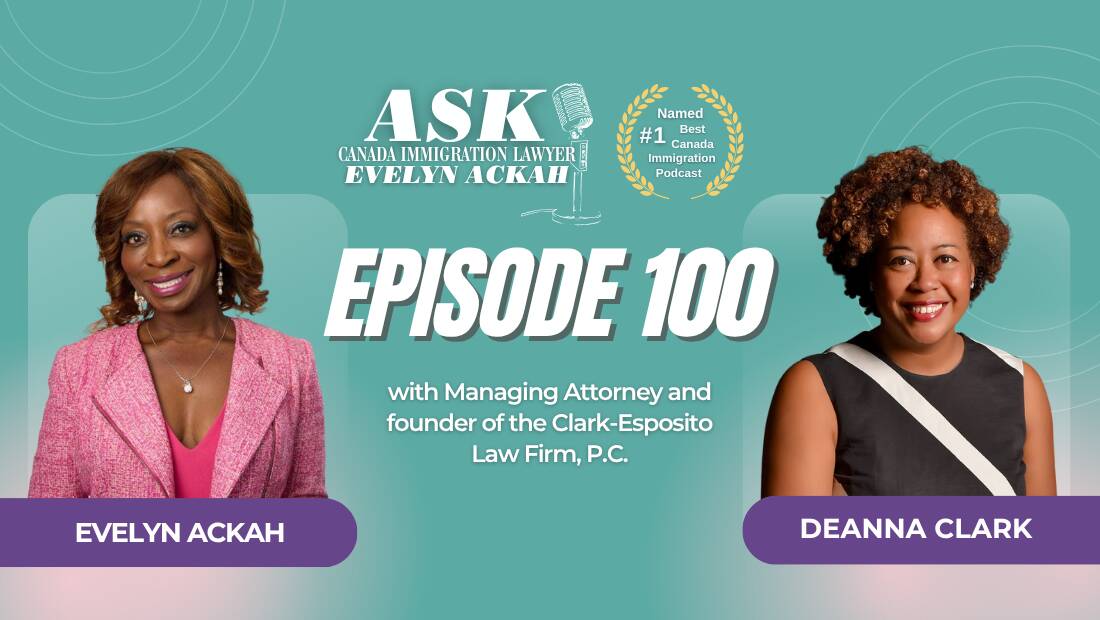
In this episode of the Ask Canada Immigration Lawyer Evelyn Ackah podcast, Evelyn speaks with Deanna Clark, Founder and Managing Lawyer of Clark Esposito Law Firm, about international trade, customs compliance and the legal challenges businesses face when operating across borders.
Evelyn and Deanna discuss what really happens when goods move from one country to another, from customs classifications and tariffs to product safety rules, seizures, export controls and sanctions. Deanna shares real examples from her practice, including businesses facing detained shipments, companies dealing with regulatory issues and individuals navigating customs enforcement at the border.
The conversation also explores the importance of planning before entering a new market. Deanna explains why businesses need to understand not only tariffs and customs requirements, but also licensing, supply chains, warehousing, product regulations, foreign investment rules and the broader legal risks that can come with international expansion.
Whether you are a business owner, entrepreneur, executive or company planning to expand into the United States or another international market, this episode offers practical insight into the value of doing your due diligence early. Having the right legal and business strategy in place before problems arise can help protect your investment, reduce risk and make cross-border growth much easier to manage.
Links to Deanna Clark:
LinkedIn: https://www.linkedin.com/in/yourcargoqueen
Website: https://www.clarkespositolaw.com
Need immigration help? Book An Initial Call With Our Client Engagement Coordinator
Here are the key points from Evelyn Ackah’s podcast with Deanna Clark:
How Deanna Entered International Trade Law
- Deanna shares how her interest in international affairs, languages and cross-border business led her into international trade law.
- After beginning her career as a litigator, she realized she wanted to build a legal practice with a stronger international focus.
- She explains how working with customs, import regulations and government agencies eventually developed into a highly specialized cross-border practice.
What International Trade Law Really Covers
- Deanna explains that international trade law affects many everyday products that move across borders.
- Imported goods may be subject to customs rules, product safety standards, food regulations, testing requirements and other government controls.
- Customs authorities often act as the first line of enforcement for several different regulatory agencies.
Understanding Tariffs and Customs Classification
- Every imported product must be classified correctly under a specific tariff code.
- That classification determines how much duty or tax may be owed when the product enters the country.
- Deanna explains that choosing the wrong classification can significantly affect a company’s costs, pricing and profitability.
What Happens When Goods Are Detained or Seized
- Many businesses contact Deanna after Customs has already detained or seized a shipment.
- She explains that Customs must have a legal basis for taking action and that businesses may have an opportunity to challenge the decision.
- Her role can involve reviewing the regulations, preparing formal petitions and presenting evidence to support the release of goods.
Why Businesses Should Get Advice Before Problems Arise
- Deanna says many companies seek legal advice only after something has gone wrong.
- By that point, the business may already be facing delays, penalties, investigations or unexpected costs.
- Early legal planning can help companies identify regulatory issues before products are shipped or major investments are made.
Real-World Customs and Compliance Cases
- Deanna shares examples involving detained shipments, product classifications, electronic cigarettes, consumer products and other regulated goods.
- She also discusses helping an individual whose cash was seized while travelling internationally because the required declaration had not been made.
- These examples show how customs law can affect both businesses and individuals.
Export Controls and Sanctions
- Businesses exporting products should understand where their goods are going, who will use them and what they will be used for.
- Certain destinations, technologies, individuals and organizations may be subject to export controls or sanctions.
- Deanna explains that companies cannot assume an international sale is permitted simply because there is a willing customer.
National Security and International Business
- Many trade restrictions are connected to national security concerns.
- Governments may closely review sensitive technologies, defence-related products, nuclear technology, encryption and other regulated areas.
- Companies operating internationally need to understand how these rules can affect potential customers, investors and transactions.
Foreign Investment in U.S. Companies
- Deanna discusses the Committee on Foreign Investment in the United States, commonly known as CFIUS.
- Certain foreign investments, particularly those involving sensitive technologies or national security interests, may require government review.
- Companies need to understand who is investing, what information they may access and whether the transaction could raise regulatory concerns.
Expanding a Business Across Borders
- Entering a new market involves much more than shipping a product into another country.
- Businesses may need to consider customs requirements, licensing, warehousing, logistics, product testing, labelling, employment rules and local regulations.
- Deanna emphasizes the importance of understanding the entire business structure before expanding internationally.
Supply Chain and Import Compliance
- Importers are responsible for understanding the laws that apply to the products they bring into the country.
- Businesses should not rely entirely on customs brokers, freight forwarders or other service providers to manage compliance.
- Internal procedures, audits and proper documentation can help companies demonstrate that they are meeting their regulatory obligations.
Operating a Law Firm and Building a Strong Team
- Deanna reflects on more than a decade of running Clark Esposito Law Firm.
- She discusses the importance of hiring talented people, learning from team members and giving employees ownership over their areas of expertise.
- Her firm also focuses on professional development, personal growth and community involvement.
The Importance of Planning Before Entering a New Market
- Deanna encourages businesses to enter new countries with their “eyes wide open.”
- Companies should consider legal requirements, costs, locations, staffing, incentives, logistics and regulatory obligations before making major commitments.
- Strategic planning can help businesses identify opportunities while avoiding preventable legal and financial problems.
Final Takeaway
- Cross-border business involves much more than moving goods from one country to another.
- Customs, tariffs, sanctions, product regulations, supply chains and foreign investment rules can all affect how a company operates internationally.
- Working with experienced advisers before a problem develops can help businesses reduce risk, protect their investments and expand across borders with greater confidence.
Need immigration help? Book An Initial Call With Our Client Engagement Coordinator
About Calgary Immigration Lawyer Evelyn Ackah
Evelyn Ackah is the Founder and Managing Lawyer at Ackah Business Immigration Law. With offices in Calgary, Toronto and Vancouver, we work with individuals and business owners from all over the world who want to cross borders seamlessly. For more information on immigration to Canada or the United States, reach out to Evelyn at Ackah Business Immigration Law today by calling (403) 452-9515 or emailing Evelyn directly at contact@ackahlaw.com.
The Ask Canada Immigration Lawyer Evelyn Ackah podcast, hosted by Calgary Immigration Lawyer Evelyn Ackah, was named as one of the Top 60 Podcasts on Immigration on the web by Feedspot.
00:01 Good day everyone.
00:04 Thank you so much for joining me.
00:06 This is Evelyn Ackah on the Ask Canada Immigration Lawyer Podcast.
00:10 And today I have the deep, deep pleasure to invite and welcome my friend and colleague, Deanna.
00:18 She's joining me.
00:18 Deanna Clark, welcome.
00:20 Hello.
00:23 I'm so excited to have you on.
00:25 This is so interesting to me.
00:26 I'm like, so many questions.
00:28 So before we get started, I want to talk and share a little bit about Deanna's background so that you know who she is and how amazing and an expert she is on all things cross-border.
00:41 So Deanna is the founder and managing lawyer of Clark Esposito Law Firm.
00:46 It is a New York-based law firm focused on international trade, regulatory compliance and global business operations.
00:54 Deanna has more than two decades of experience, even though she looks like a baby.
00:58 She helps businesses navigate the legal and regulatory challenges that come with operating across borders, and her practice includes advising companies on import and export compliance, customs regulations, sanctions, supply chain risk management, government investigations and international business strategies.
01:17 She works with organizations ranging from growing businesses to established companies operating in highly regulated industries, helping them manage risk while pursuing global opportunities.
01:30 Welcome, Deanna Clark from Clark Esposito Law Firm.
01:36 Hi, thanks.
01:39 Thank you so much.
01:40 I'm excited because I don't know a lot of international trade lawyers. In my 25, 26 years of practice, there's a few that I've come across, and I was just so excited that we've gotten to know each other.
01:51 So I'd love you to share, how did you get to this place?
01:56 How did you find this path? Because it's not the most traditional legal path for people.
02:02 So how did you find international trade and compliance in your journey?
02:05 Yeah, thanks for the question.
02:07 You know, I think what I want to do is just take a step back because even with other attorneys, I find that they're not even sure what that means to be an international trade attorney.
02:19 OK, thank you.
02:20 So, you know, even just if all of you listening, just take a look around the room you're in right now.
02:26 You know, really look at just the variety of things you've got in there.
02:30 And I want you to appreciate that virtually everything in that room is from another country.
02:35 And so it's OK, we all know this, and maybe we don't have an awareness, but it's like, yeah, I know so many things are made in China, or when I'm out shopping, this is from Bangladesh, what have you.
02:48 And so, you know, can all of these things come into our country?
02:53 Is anything governed by some other laws? These laptops or desktop computers we're looking at?
02:59 Is there a level of radio waves that can be emitted?
03:02 Is there supposed to be some level of, let's say, some of the cleaning things you have under your kitchen sink?
03:10 You know, are there maximum levels of toxicity, if you will, that's permissible, and even in our food?
03:17 How old can food be coming in, or how much pest residue? You know, basically when things grow outside, there will be bugs, and no one wants to hear that, but it's what level of pest residue is permissible and what isn't.
03:30 Well, these are all questions that come up when goods are entering into our country.
03:34 And being based in the U.S., I'll be referring, you know, to U.S. Customs.
03:39 And so problems can arise with companies who import. They're called an importer, bringing something into the country, because U.S. Customs, they function as the watchdog of our border. And so it's not just for people, but it's for anything coming in, including, in this case, commercial goods.
03:58 So because they're the watchdog, it means they're also looking out for the interests of, like, our U.S. Food and Drug Administration.
04:07 I recall a story about a shipment of shrimp that had come in and it didn't pass FDA's, or Food and Drug Administration's, sniff test, right?
04:18 Nobody wants to smell stinky shrimp, right?
04:21 But you know, it's, oh, OK, it didn't pass.
04:24 So what happens is Customs holds the merchandise on behalf of FDA so that this food issue can be resolved.
04:32 We just had a client who had some go-karts.
04:35 They had two things.
04:36 They had go-karts for children.
04:38 They also had, like, a chair, a reclining chair with a remote, you know, those things you love to get into, but maybe you don't want to have one in your house, or at least have anyone see it.
04:50 But an issue had come up with, you know, what level, or did it have the right testing?
04:57 There's a company called UL, Underwriters Laboratories, and on a lot of our electronics we'll see a UL symbol with a circle on it.
05:04 And so they do certifications, and so certain things need to travel with the cargo so that U.S. Customs knows that, hey, this is permissible into the United States. It won't hurt our people because it's been certified. And all of this, by the way, just rotates around national security, protecting our people, and it's the same, you know, with Canada's structure.
05:27 And quite frankly, it's the same with every structure. And then, as we've seen, tariffs in and of themselves, which is just a tax, like a sales tax, but one related to goods coming into a country, those can be used as a trade tool.
05:45 I'll use that word very diplomatically, you know, and we've seen China do this as well. You know, it's not only the U.S. doing that.
05:55 We had a client, you know, this concept of retaliatory tariffs, where if you're going to tax our made products that go to your country, we will do the same.
06:06 I remember last year a client came to us and they said, you know, a customer has ordered a machine. We have been doing, you know, the fine-tuning, if you will, to its specifications, but for us to send it back to them, this was an export to China.
06:22 Out of California, it's going to cost that company, just to import it, a payment of $1.2 million, the equivalent in Chinese renminbi, in their currency.
06:33 And so, you know, we're talking about a machine that was just $250,000, and now there's all these extra—so coming back to, you know, this area of law, how did I even get into this path?
06:49 I had had an interest in really all things international.
06:54 By the time I had come out of law school, I had lived abroad a few times.
06:59 I had, at that point, a couple of languages under my belt, one, Spanish, being very strong, French being so-so.
07:08 Right now I still have those languages.
07:10 I also speak Italian.
07:12 I've been learning Greek, and I like to talk, as you might have noticed, so, you know, it follows that I would learn these languages, but just having this interest in international affairs and what have you.
07:28 I wanted to find an area of law that would allow me to look at documents in other languages, that I could think about, well, how might this transaction work or translate, or what things might there need to be protections around? And I had actually been in St. Petersburg, Russia.
07:47 I had been working as a litigator my first few years out of law school, which was more than 20 years ago at this point, and I was at this Uzbek restaurant, and the moment I stepped out of the door, I said, I've got to change my life.
08:06 It was very important to me to do something international, and I love the thought process of being a lawyer, but I wanted to do it in this international arena.
08:13 And I do say I was lucky to get into it because, as attorneys involved in customs law, and I'll talk a little bit more about the export-related side, but we're maybe 500 who are practising, like actual practising attorneys, in the country.
08:30 So there's very few of us when you take into consideration many major cities have at least a couple hundred real estate attorneys in the one city.
08:40 It was essentially a three-line job ad that was acronym soup: CBP, which is U.S. Customs, FMC, Federal Maritime Commission.
08:52 CPSC, Consumer Product Safety Commission. You know, and the idea was, yes, we do customs-related work, but because they are the watchdog of all of these other government agencies, any familiarity with them would be important to have also. And after something like nine hours of interviews, I went ahead and joined that firm, and I stayed there eight years, so I was able to learn a ton about import law that related to customs brokers, freight forwarders, the logistics providers.
09:23 And then I moved on to exports.
09:25 That's amazing.
09:26 Well, thank you for that background.
09:28 I really appreciate it.
09:30 Deanna, it sounds like such a unique background to kind of get you where you are now, as the head of your own law firm, you know, and operating in New York.
09:40 It's just an amazing, amazing journey.
09:42 So one of the questions I have for you, I spend a lot of time moving and helping businesses move people across borders, and you help businesses move products and operations.
09:52 How does it actually work?
09:54 Like, can you give me, because you started off with a little bit of storytelling, which I loved, some of the case studies, but if you can give me one example from beginning to end of how a file looks for you, I think that would give people a really tangible understanding of what your days look like.
10:12 That would be really cool.
10:15 Better to tell it in a story than to see it in reality.
10:17 I'm running around.
10:21 No, our firm is actually quite organized.
10:24 We have a lot of standard operating procedures and, you know, work as a team, which also helps keep pricing down for clients.
10:34 You know, a typical case.
10:36 So first of all, generally, companies come to us when they have a problem.
10:43 It's almost never the case, I'll start with the customs side.
10:46 It's almost never the case that a company says, you know what, I think we can save money by sourcing from such-and-such country under this free trade agreement.
10:55 Let's hire an attorney to find out.
10:58 It's really, oh, Customs has seized our container, we can't get to it, or, oh, Customs has shown up at my door.
11:06 What do we do?
11:08 And of course they can sort of paper an investigation, and there's the prelude to an investigation, which could be where they make a request for information on a Customs Form 28. They may actually take action.
11:23 And action oftentimes is where an importer, on their customs declaration saying what the cargo is coming in, they go ahead and say, you know, you gave it this 10-digit classification number.
11:36 We actually think it's this 10-digit classification number, and then they increase—that leads to an increase in the amount of duties.
11:44 So now you're on the hook for more.
11:46 And, you know, unfortunately, and this is something we see when companies want to enter into the U.S., I'll use that as an example.
11:58 It's that they haven't done their math right.
12:01 You know, it's sort of, hey, there's a good deal, this manufacturer is willing to make this, they've helped us work on the designs even, and we're ready to do orders because we've done some test orders.
12:11 But what they don't always do correctly is determine what is the actual tariff classification number, because for everything from your eyeglasses to if it's a women's top of cotton, which will be different from a men's top.
12:28 Of a blend with cotton potentially, you know, what is the actual tariff number? Because that has the corresponding rate of duty. And duties, this tax, it's—to give you an idea, if a woman's shirt was subject to a 10% rate of duty, then for every $100 that comes in, $10 needs to be paid in this tax, which we call duties, to U.S. Customs.
12:54 And so just, you know, that's the math of it.
12:57 And if the number is not what you think it is, then your actual cost for running your business, your cost of goods sold, ultimately that you're going to make sense of what your profit will be, that won't be done correctly.
13:11 And so, you know, that's always something to keep in mind.
13:14 But coming back to a typical day.
13:16 It's really going to relate to the problem du jour.
13:19 Customs law is, I say, it's one inch wide and one mile deep. And what that means is, and I'll stay with the case of a seizure, which is quite common, where goods come in and Customs sometimes simply detains them.
13:34 I have a meeting coming up, you know, in about one hour related to a shipment that's been detained because of an FDA hold.
13:42 Only that happened in April, and so they've been waiting for something to happen. Now it hasn't, so, OK, we need an attorney now to step in to help.
13:52 But it's which laws were at issue.
13:56 Customs can only seize something under—you know, a seizure occurs under a particular regulatory framework.
14:03 And so there needs to be a legal basis.
14:05 Ordinarily, there's one to three that are raised.
14:09 I was talking yesterday with someone about drug paraphernalia.
14:12 And I'll use this as an example because it's simple.
14:16 If pipes have been imported, on the customs declaration form it would indicate pipes.
14:21 And this is a real case I've dealt with, by the way.
14:24 So where there's a seizure and the allegation is drug paraphernalia, and it's been properly classified, it's, we're seizing this on the basis of drug paraphernalia.
14:34 Where, however, let's say a shipment of bongs—we had this case come in—and it looked kind of like a thermos but obviously outfitted for other purposes.
14:45 And so the importer had classified them as kitchenware.
14:50 And so when Customs is looking at this, they're like, this definitely is not kitchenware.
14:57 So there's the violation of attempting to import drug paraphernalia, plus the violation of, you know, ideally they don't consider it fraudulent, but it's an inaccurate or incorrect declaration for Customs, and with the seizure will come a penalty oftentimes.
15:16 So when a case comes, it's OK, what are the laws affected?
15:19 Last week I was writing up a petition to defend a client against 18 cited violations, which truly is an unprecedented number, but, you know, that's what it was.
15:32 And it's, let's prepare the petition so that it is a formal response to say, hey government, give us back the goods. We have an interest and title to these goods.
15:43 And here's why we didn't break the law.
15:47 You know, and may I give an example related to this?
15:52 So we had a client who manufactures e-cigarettes, and what they did was they imported empty, so unfilled vape pens, so just the e-cigarette shell, if you will.
16:07 With it, however, was packaging that talked about a smooth hit.
16:11 And all these things alluding to, you know what, cannabis.
16:16 And so, you know, upon speaking with the client, it's, yeah, actually there was an opportunity to fill it with some kind of CBD oil.
16:25 And so we went back to Customs and we said, look, at the time of importation, these things are 100% legal.
16:34 They're empty vape pens, not a big deal.
16:37 Now, of course, we can't ignore the elephant in the room, which is, yeah, but Customs is considering these drug paraphernalia because they're packaged with something that suggests it will be used for nefarious purposes.
16:49 And so we laid out for them how, in fact, it was intended to be used with CBD oil.
16:55 CBD, under changes to the Agricultural Improvement Act, led to this whole industrial hemp system.
17:02 USDA approves the states' plans.
17:06 Colorado, where this product would be coming from, everybody in that supply chain had a licence, and we went ahead and laid out the law, included the licences, and we petitioned for their release on the basis that this whole thing was legal now and intended for lawful purposes.
17:23 They went ahead and released the goods, and the value of the shipment was about $70,000, but the retail value once filled was about $700,000.
17:34 Yes, and so, you know, meeting with clients, it's, OK, well, here's the value of the shipment, but what's your real value, right?
17:42 What's your profit in that?
17:44 What basically do you have to lose if you can't get these?
17:51 No, look, not everybody wants to hire a lawyer and get the help because it still is a several-thousand-dollar investment and you don't know what's going to happen, right?
18:00 We cannot guarantee anything as counsel.
18:03 But we can guarantee you'll put your best foot forward, you know, in using us to represent you.
18:09 So I love that. That's a great segue into, like me, sometimes I have clients who try things on their own, and then they don't work, and then they come to you.
18:18 So have you ever had clients call you after the fact, wishing they'd involved you, or they've made their situation even worse?
18:29 Pretty much every day.
18:32 And then, you know, in terms of, so I'll just make a comment on people and companies, which are run by people, but those who may elect not to work with us.
18:45 It's not always a price objection. You know, we're not the cheapest, of course that's going to happen.
18:50 But some companies aren't ready to hear that they not only have the problem they think they have, that they have a whole host of other problems.
19:02 They're just not ready. They become afraid.
19:17 And so where we were to come in, we would essentially out them, you know, with respect to how they have not been performing adequate due diligence and tip them off to the big penalty that is not about if, but when. When is this coming?
19:35 So people don't always want to hear the truth, or they can't handle it.
19:39 They can't handle it.
19:41 Thank you, Jack Nicholson.
19:42 They can't handle the truth, right?
19:45 A Few Good Men.
19:48 You know, in terms of kindness, I would say most companies—and I'll even share an individual story—every now and again we have an individual with a customs problem.
19:59 It's almost always last minute, and it's, we either couldn't find anyone because we're hard to find, although we actually have a video library at the Clark Esposito Law Firm YouTube channel of over 100 videos on customs and export controls topics, but we're still hard to find.
20:18 So they'll come at the last minute.
20:19 We had a client come to us.
20:21 It was a referral from an immigration attorney, actually, come to think of it, but it was a personal matter.
20:27 A guy, his dad had tried to travel to Vietnam and he brought with him just under $15,000.
20:37 When you exit the United States, if you're carrying $10,000 or more in cash on you, you need to just let them know, hey, I'm leaving the country with this money.
20:46 And he did not know that. Ordinarily he travels with his son.
20:50 They actually bring money back to Vietnam to give to relatives, along with to make donations to different Buddhist temples.
20:59 And so Customs seized all of his money, some of which was also his travel money.
21:05 He managed to board the flight the next day, still went to visit family, but wasn't able to distribute the funds as he'd intended.
21:12 And they only came to us the very day before their deadline to respond to the seizure notice.
21:22 And it's like the son worked at a place where his manager happened to know my friend who's an immigration attorney, and this is how we met. And I stayed on with them maybe till 10, 11 at night because what needed to happen was to engage our firm, give us power of attorney, so we could turn around and say to Customs, hi, we were recently retained.
21:43 Can we have an extension?
21:44 And essentially what we did was, what needed to be overcome was, was this money obtained from lawful means and was it intended for lawful purposes?
21:56 So we went ahead and traced, you know, where the money had come from. So some from the daughter paying rent, some from one person's job. He was carrying money for the son over, who was also donating, so some from his job.
22:09 We laid all that out, who they worked for, how long. We went ahead and provided—there's guidelines for any sort of, hey, release this or reduce that penalty, and we weren't to a penalty stage yet.
22:23 But it's on this basis, here's why this money should be returned to the client.
22:29 And Customs came back and said, OK, well, show us the tax returns.
22:34 Well, we didn't have tax—it turns out they didn't file tax returns the prior year, but we went ahead and got all of the pay stubs and sent those over as attachments and, of course, organized that into tables to help explain to Customs what was what.
22:48 Well, they came back, and we also, by the way, traced through on Google Maps, like here's where this Buddhist temple is, because Vietnam doesn't have addresses the way we have in Canada or the U.S., and it's the Mekong Delta.
23:03 It's all jungle, and the client had originally come out of the Vietnam War as a refugee, living in a refugee camp in Thailand and then in the Philippines.
23:13 So we just traced the whole story about this very hardworking, dedicated man and his intent to do good.
23:20 In the end, Customs let us know, we accept your petition, $500 penalty, and they returned the other $14,000, what have you.
23:29 And you know, this client only made about $45,000 a year, and that he had tucked away all that money is truly remarkable.
23:41 So an amazing story.
23:44 I love that.
23:45 I love the stories because it just really gives concrete substance to what you do every day.
23:53 And I didn't know that you would help somebody on a personal matter like that. To me, that's new.
23:57 I always think about it as the stuff from China or the stuff that's going somewhere else or coming to Canada.
24:01 Canada, or the products, but not the fact that somebody travelling with more than the $10,000, which most people know from an immigration perspective too.
24:10 You get asked the question, do you have more than that with you?
24:14 But I didn't realize you did that.
24:16 That's amazing, amazing.
24:18 What a great outcome for them, huh?
24:20 Yes, for sure, for sure.
24:23 So Deanna, what kind of trends are you watching right now that you're seeing in your business area around?
24:31 You know, what is happening when it comes to your work in terms of cross-border trade?
24:38 Are you seeing some trends, like besides tariffs, tariffs, tariffs everywhere, which we hear about every day on the news, especially as Canadians? Are there other kind of current changes or things that you're seeing that are trending that would be of interest to our listeners?
24:56 Yeah, so I definitely see a few things trending aside from the tariffs.
25:03 This administration, you know, we are seeing a lot of scrutiny by our government on all things international.
25:13 I mentioned before we have the export side of the firm, and what I mean by that is export controls and things governed by sanctions.
25:21 So all that means is that if you want to sell something overseas and increase your sales through foreign sales, you have to be cognizant of where is it going to, what will it be used for, and it's going to be used by whom.
25:38 These are the three questions that need to be asked in order to ensure it's not triggering what's known as an export control.
25:46 And an export control is just our government's way of saying there is a body of destinations, individuals or institutions, or the so-called persons, which can be corporate persons, and uses, which we consider potentially touching on a national security concern.
26:06 Therefore, where you want to send your goods, and maybe you've got a great, you know, wow, they really want to buy a lot from us.
26:14 But if it's somehow, whether the party buying it, there might be an issue.
26:19 If it's something sensitive related to photons, you know, these technologies, critical technologies, nuclear, for example, you know, it's not just, oh, you want to ship some guns.
26:31 You know, that's sort of an obvious, right?
26:34 But for all these other things, encryption software, there are things that we use on a day-to-day basis to send emails, for example, but where else in the world might that be heading to?
26:44 What are all of those laptops being used for?
26:47 And in whose hands? Is there some militia group, you know, in a country known to be training terrorists or known to be conducting this human rights violation?
27:00 Our government wants to know where those things are going. And, you know, also as we've seen this year, we have seen actions with, you know, Iran's the most recent, Venezuela, the U.S. had taken action, and then we have sort of more recent big news and then we have just long-standing, like with Cuba.
27:20 You know, countries where, whereas Canadians love going to Cuba and you have no restrictions to go, we have a very limited way that we can go, and we can only go because those limited ways fall under what's known as a general licence, and then for anything that is not within that—
27:40 You need to go and ask for a specific licence, and if it's not granted, it's just not permissible, right?
27:47 And where you do it anyway and don't get caught leaving the country, then there's some big penalties, and if there's a fraud case that may be brought by our Department of Justice, you can find yourself in jail.
27:59 So it's pretty, you know, it's pretty—
28:01 Critical.
28:03 And I'm sorry, I'm realizing I don't even remember.
28:07 No, it was great.
28:08 It was about trends, but it sounds like you've been, you know, you shared that what's happening besides tariffs is just generally where people are dealing with exports as well.
28:19 So is there anything else on the trends piece that you're noticing?
28:23 I think with this increased scrutiny, we've had an increase in what are known as sanctions, or restrictions on what can and can't be done.
28:33 Just in May, our Office of Foreign Assets Control, OFAC, they announced, hey, companies who want to do things with Cuba, where you're doing something and it may be defence-related, or if you want to sell certain things to the Cuban government—
28:51 You'd better stop.
28:54 It was sort of this—it really truly sounded like a threat to me—but it was, we're going to cut you off from other commercial benefits with the United States where you proceed to engage in sales of certain merchandise with Cuba.
29:08 And so, you know, whenever you see something like that happening, then it's, is that a prelude to what we'll see with other countries where there are sanctions, but there are exceptions and exemptions to that?
29:20 So some things can be done.
29:22 It's, you know, it's almost this extension, and the U.S. has always been this way.
29:31 And of course we saw how this has played out with Iran, and certainly very close countries like Australia with the U.S., you know, where their leadership, President Albanese, is, you know, look, you never came and talked to us about it.
29:44 You just went ahead and did it.
29:45 And I'm sure, you know, Carney is no different, right?
29:48 It's, hey, you did it.
29:51 We didn't have a game plan.
29:53 And so ordinarily, yeah, we are united, but we also need to be united in the decision.
30:00 So, but you know, this administration certainly has a different approach to—
30:08 Everything has changed, yeah, all around the world.
30:13 So we're seeing this kind of an uptick related to companies here in the United States who are attracting foreign investment.
30:21 So obviously, like Canada, we have a ton of innovation happening here, and not just in the very popular Silicon Valley.
30:29 You know, close to my hometown of San Francisco.
30:32 Innovation is everywhere, and foreign companies want to go ahead and invest in our country's companies.
30:38 Well, out of our Department of Treasury, which is where OFAC is, is another office known as the Committee on Foreign Investment in the United States. CFIUS is their acronym.
30:49 And CFIUS as well has a process by which it can be mandatory, it can be optional, so it just depends. Like if it's a critical technology, it's mandatory.
31:00 You must, before a foreign investor can move any money over for you—
31:05 Become a full owner, partial owner, investor, you have to tell CFIUS about this.
31:11 And that's a whole formal process guided under the regulations, and the government wants to know, OK, if you have this investor, who's buying into you?
31:20 So we have a client in nuclear, for example, and they have a foreign investor. It's a minority investment. That makes no difference.
31:28 It's what's their background, who are the owners, because we're dealing with a sensitive national security area.
31:35 And so it's, once they become part of the company, will they have access to all of the information, all of the specifications, and then who is that going to be turned around and shared with? Who's on your board, or who is a shareholder who may turn around and take that technology, incorporate it into something else—
31:54 That can now be turned around and hurt the United States.
31:57 So we've seen an increase in investigations arising with CFIUS, along with just, everybody be sure to come in.
32:06 CFIUS is a panel of leaders from the different government agencies.
32:11 So, for example, an agency in particular that would be interested in this nuclear company is our Department of Energy.
32:20 Our Department of, what's now called War, but formerly Department of Defense.
32:25 So those agencies want to ensure, if this other company is buying in, you know, hang on, if you're doing something and already selling goods to us, are you going to maintain that technology so that if we want to buy some more, you still can make that for us?
32:41 You know, the agencies will have their own interests, and so they want to ensure that that can happen, what have you. In any case, without getting too deep into it.
32:51 That's so interesting.
32:53 Deanna, what about cross-border?
32:55 Like, you know, we have Canadian businesses that are doing business in the States or want to do business in the States.
33:02 What kind of assumptions do you think are made commonly that may be wrong about Canadians moving south or Americans who want to do business in Canada in terms of your trade focus?
33:17 Yeah, so it's interesting, you know, our approach—and our approach isn't for everyone—but even though we're dealing with Customs and imports, we recognize that because of the nature of how U.S. laws, from whichever requirement there may be, attach with imported goods, this is a starting place for companies who are looking to come and do business in the U.S. And it's no different, and we've done export—
33:46 You know, sort of this gauging the marketplace. What other regulations might there be? And we can partner with another law firm in another country, but there needs to be a baseline of due diligence because our systems are different.
34:02 Depending on what it is, are we talking just a shipment of ballpoint pens?
34:07 Are we talking about cooking oil?
34:09 Are we talking about something that could be a hazardous material, or in a particular quantity, since we're importing a commercial quantity, that much of that, you know, is now considered hazmat?
34:22 And so it's understanding not just how do we get this through the border and what will it cost, but it's what is required now at the facility it's going to.
34:32 Do the parties importing this have to have some other U.S. licence?
34:36 If we're going to leave this at a warehouse, so if anyone knows what a 3PL is, or a third-party logistics provider, if it's heading into one of their warehouses, what else is necessary?
34:48 Or if something is electronic that contains batteries, what type of stickers need to go on the outside of the boxes so that we're sure to be doing this in the right way?
34:59 So part of it is who is in your supply chain, and even vetting that freight forwarder who's going to be helping you with it, or if you have a warehouse that's going to open up, repackage, and then you're, you know, now you're selling a kit.
35:13 I find a lot of this pre-planning doesn't take place, and it doesn't take place because no one's thinking to ask you questions, right?
35:20 So, and of course that kind of a thing can lead to problems. But separate from that, importers have their own import compliance requirements under what's known as the reasonable care standard.
35:35 This came about in 2003 from the Customs Modernization Act.
35:39 And it's just, what laws apply to what you're importing?
35:44 Do you have that documented somewhere, and are you following it?
35:48 So Customs would want evidence that you know the law and you're actually abiding by it, and you know you're abiding by it because you periodically conduct internal audits to make sure. You maybe have counsel who helps you understand what the current laws are.
36:02 Something that always happens is an over-reliance on their customs broker.
36:08 The customs broker, you know, yeah, they're doing the filing for you with your customs entry.
36:14 They're the ones who come up with your tariff number.
36:17 But U.S. Customs' position is that importing is a privilege, it's not a right.
36:22 And so the onus is on you, the importing company, to tell your customs broker—
36:29 Actually, this is the right tariff number. But most companies are not thinking about that.
36:35 They're also not thinking about, if I hire people, what a lease might look like. Does the U.S. have stronger laws? You know, we do have strict laws.
36:47 We do, you know, some more strict, some less strict.
36:52 With respect to human resources matters, you know, I would say we're actually looser. We may be more expensive than a lot of countries, but compared to even Canada, I would think in terms of sort of protecting workers' rights, our laws just are not as strong.
37:09 You know, so when I say some companies would prefer not to use our approach, it's that we're looking at the whole picture.
37:18 If children's wear is being imported, well, do you have your general certificate of conformity because you've had the certified test agencies test for, if it's paint, you know, if you have a T-shirt with some cute design on it and that's paint, have you tested for lead levels?
37:36 Are you trying to import something with beads?
37:38 Well, you can't do that on children's wear, you know, and all of that is governed by our Consumer Product Safety Commission.
37:45 They're the enforcement agency, and so Customs will stop that coming in.
37:49 I even had a hair dryer case where hair dryers can only be two-pronged now, and it was the three-prong, and this was actually a Canadian case.
37:57 And so now we're stuck at the border, and what do we do with it?
38:00 Oh my God, I love this.
38:02 It's like your work is never boring.
38:05 This is always different.
38:07 So when you say, and I say, what's an average day?
38:10 There's no average day.
38:11 It sounds like to me.
38:13 That's what keeps it really exciting, I think.
38:16 So let's circle into the fact that you've been operating a law firm like myself.
38:22 You're leading a firm, you're leading a team, highly respected niche area of practice, well known all across the U.S. and internationally. What are a few lessons you've learned along the way as an entrepreneur and a law firm owner? Because you work for businesses, but you're also running a business.
38:42 So how has that experience been for you?
38:45 And, you know, I mean, I've got years of experience to talk about.
38:48 We could talk for hours, just like you, but are there a couple of experiences or lessons along the way that have helped improve you, let's say, as a lawyer, even for your clients?
39:01 Yeah, it's interesting. You know, it's like, how much time can I spend on the business versus in the business, as we've heard? And it's always a challenge.
39:12 Of course, hiring people and growing the firm. You know, we just celebrated our 10-year anniversary.
39:19 Thank you, thank you, thank you.
39:23 As you know, our people are the key to running a successful company, and I think any business owner would agree.
39:32 Then it's a matter of, how do you find those people? And I find, it's not only letting them know, because the kind of law that we do, everybody needs to learn some portion of it.
39:46 I'm interviewing right now. This attorney candidate has experience with both OFAC and Customs.
39:52 I have no doubt he too will have some kind of a learning curve, and I also have no doubt that I will have an opportunity to learn a lot from him.
40:03 Something I did early on was to hire attorneys, hire people with more experience than myself, and I don't just mean at the attorney level.
40:12 I've had, in fact, when ChatGPT came about, the fall before everybody came to know it, you know, he literally was like, Deanna, I need you to come look at my computer.
40:22 I need to show you this.
40:24 And so we were an early adopter to having ChatGPT working with us to write SOPs.
40:29 We don't use it for any legal work, by the way, but in terms of improving workflows at the law firm, we definitely use it for that.
40:42 So I don't consider ChatGPT—and we don't have any happy robots or any AI agents helping us at the firm.
40:50 Although I'm sure some listeners do, you know, and maybe you consider them part of your team.
40:55 But it's really, once they have learned a certain amount, then I sort of, you know, I pass it over to them to take agency over—
41:05 Their role.
41:06 I let them know from the get-go, what you have to say matters.
41:10 I want to hear your voice.
41:12 I don't know everything, and I make it clear, like, you know about this. I saw this on your résumé, you shared more with me during your interview, so I want you to lean in on this skill that you have.
41:23 And I find that when we take everyone's contributions, the firm continuously improves.
41:29 Our values include both professional and personal growth and development.
41:34 We have an education program where we'll sponsor and pay for, you know, some kind of education.
41:42 We're paying for someone who wants to take pottery classes.
41:46 This is enriching her and gives her time to do something for herself and not just be in mom mode all the time.
41:54 We just launched with our anniversary our new volunteer program, CELF in the Community, where anybody at the firm has 20 hours of volunteer time.
42:11 They have to get something from the organization verifying this, and then we make a monetary contribution to that charity.
42:20 I love it.
42:21 I love how you're running your business and the values and the people-first kind of focus.
42:27 I love it.
42:28 No wonder you're doing so well.
42:30 Really, it's so nice to hear, but even though a lot of lawyers say the same things, I feel like knowing you, you're living it.
42:39 You're not just talking it, and I think that really sets you apart.
42:44 So before we wrap up, my dear Deanna, if you could leave business owners with one piece of advice about operating across borders or operating in a tariff, trade world, compliance audit world, what would that one piece of advice be?
43:00 Hire you first, is what I would say.
43:03 Well, ahead of the curve, if you can find us. You know, I mean, we're findable, but of course, you know, I think—
43:11 What's critical to me is that—
43:15 People are starting businesses or people are taking a step into a new country, even if they're, you know, someone starting with an assistant of a vice president or the vice president themselves, wherever you are in the corporate structure.
43:29 Any new market.
43:30 I want you to go into that with your eyes wide open, right?
43:34 And so that list of, oh, what do I need in my eyes wide open?
43:38 That, of course, is determined on what are you doing, you know, and is this the same line of business that you're trying to do?
43:44 Are you trying to offer something else in a different market?
43:48 Let's say we decide to go to Canada and we're going to open up something where it's—or maybe vice versa, let's say someone is coming to the U.S. But the idea is if you, Evelyn, you want to have an office in the U.S. because you're able to, you know, work both sides, if you will.
44:09 So there's this consideration.
44:11 In terms of the Canadian side being in the U.S., well, now you're going to have these things.
44:16 If you co-own property, if you co-own property prior to having permanent residency, if then, you know, then what, right?
44:26 And it's OK.
44:29 Well, if you're heading into the U.S. to open up, you know, Ackah Business Immigration Law here, then what do you need? What do you need to know about? If you're hiring people, oh well, we have placement agencies. You can always just hire a temp and pay a fee.
44:46 OK, well, that might be better than, oh, I have an employee and now they're pregnant and now I've got this triggered and that and this and the other.
44:55 Do you even want to have, you know, how many people, what have you?
44:58 Do you want to be in a business park?
45:00 How many people do you plan to hire?
45:02 Some of our states have different incentives in certain cities or counties, so that businesses who plan to employ 10 people get a huge tax break. You know, so that little bit of due diligence, it can help you save money.
45:16 So it's not just about how do I do this, but where best, because we can save—
45:21 Money because we can put up a billboard and we're right off the freeway at that exit. You know, it's really more of this strategy piece.
45:30 And I find because no one is really thinking about how might the laws impact these strategic decisions, that would really be a place in terms of what can I share. Non-attorneys will have lots of ideas on things to share.
45:44 But I think really this alignment of law, plus if you're importing—
45:49 OK, well, what port is it coming from China?
45:51 Will you always be having the port used through L.A., Long Beach?
45:55 Well, that's got to be trucked over, or do you have a warehouse?
45:59 You know, how do we want to plan this?
46:03 Forethought and real strategy, which for me means hiring somebody in advance, not after the fact.
46:10 I really believe in that.
46:11 I tell my clients the same.
46:13 It's always easier to do it right the first time than fix a problem.
46:17 You know, it's harder for us if they come and they've done it and it didn't work.
46:21 Now they have a record of a failed attempt, and now I have to try to fix it and clean it up.
46:27 So just like you, I would say, please contact Deanna first at Clark Esposito Law Firm and do it right the first time, and then you have a trusted partner on your team.
46:38 I think that's how I think you practise, like me, is—
46:42 You want people to treat you like you are part of their organization so you can give them even more value, right?
46:50 Definitely, and we're in the business of helping people.
46:53 We just happen to be lawyers, you know, but at the end of the day, it's how can we best help you?
46:58 And this is why we never just look at a customs issue—
47:01 Exclusively and in a vacuum.
47:03 We actually need to know about your business so that we can best help the business move in the direction of the business owners.
47:10 Oh, what a wonderful way to wrap this up.
47:14 Deanna, thank you so much for joining me.
47:17 Thank you.
47:18 So interesting and so exciting.
47:19 I'm like, I should have become a trade lawyer.
47:21 What was I thinking?
47:24 I'm so jealous because now you got me looking at everything around my office and my house, and I'm like, where's that from?
47:31 Oh, I wonder. But I'm going to be doing that now thanks to you.
47:34 You really planted that visual so perfectly.
47:38 And so for all of you listening, I'd like us to thank Deanna Clark from Clark Esposito Law Firm, based in New York City.
47:45 I'm going to share all of Deanna's contact information in the show notes so you can reach out to her and her amazing firm if you want to learn any more about her services or engage her services as an amazing professional.
47:58 And as a friend and colleague, I want to say thank you so much for joining me, Deanna.
48:03 Thanks for inviting me.
48:04 Wonderful.
48:05 You're the best.
48:06 Thank you.
48:06 Until next time, thanks for joining me on my podcast, everyone.
48:10 Take good care of each other.