



Or listen on your favourite podcast app
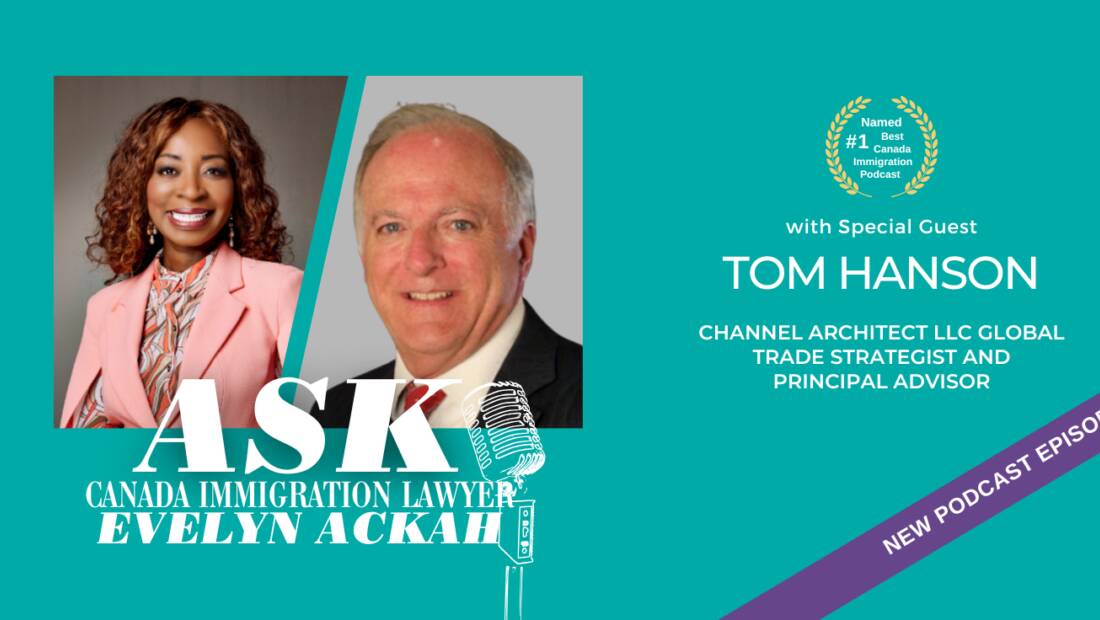
In this episode of Ask Canada Immigration Lawyer, Evelyn Ackah speaks with Tom Hanson of Channel Architect LLC, a global trade strategist and Principal Advisor, about the deep connection between international business expansion, cross-border mobility and the systems that make global commerce work. With more than 30 years of experience across the private sector and as a former U.S. Foreign Commercial Service commercial officer, Tom shares practical insight into how companies and governments build market entry strategies, form strategic partnerships and navigate complex international procurement and investment environments.
The conversation explores what it really takes for a business to expand internationally, from assessing commercial viability and scalability to building trust-based partnerships that can withstand uncertainty. Tom breaks down how he supports small to mid-sized companies through phased engagements, why due diligence in partner selection is critical, and how cultural awareness and ethical decision-making shape long-term success across different regions and industries.
Whether you advise corporate clients on cross-border immigration, support global entrepreneurs or work with employers managing international growth, this episode offers valuable perspective on planning for change, protecting reputation and building partnerships that help businesses thrive in an unpredictable trade environment.
Links to Find Tom Hanson:
LinkedIn: https://www.linkedin.com/in/hansonglobal
Website: https://www.channelarchitect.world
Need immigration help? Book An Initial Call With Our Client Engagement Coordinator
Here are the key points from Evelyn Ackah's podcast interview with Tom Hanson:
Global Trade, Immigration and Business Expansion
Explores how international trade and immigration are closely linked, particularly for corporate clients expanding across borders
Highlights why workforce mobility, supply chains and market access must be considered together in global growth strategies
Career Path Across Public and Private Sectors
Traces Tom Hanson’s journey from international sales to the U.S. Foreign Commercial Service and back to the private sector
Shows how experience in government and diplomacy strengthens strategic advisory work for businesses and governments
Assessing Readiness for International Expansion
Emphasizes the importance of commercial viability, scalability and intellectual property protection before entering new markets
Introduces the concept of a “pre-flight checklist” to determine whether a company is truly ready for global expansion
Building Trust-Based International Partnerships
Stresses that partner selection is one of the most critical success factors in cross-border trade
Warns that poor partner choices can damage brand reputation and derail international growth
Highlights trust and shared values as essential to long-term resilience
Navigating Trade Uncertainty and Tariffs
Addresses how tariffs and trade policy shifts create fear and unpredictability for businesses
Encourages companies to focus on what they can control and remain ready to pivot as conditions change
Frames adaptability as a core strategic advantage
Cultural Intelligence and Ethical Diplomacy
Explores the role of cultural awareness, respect and ethical standards in international business
Highlights the importance of adapting communication styles across regions without compromising integrity
Global Trade Trends and Emerging Markets
Identifies growing opportunities in South and Southeast Asia, Africa and South America
Discusses optimism around the future of USMCA/CUSMA and the strength of the North American trading bloc
Key Takeaways for Immigration and Business Professionals
International expansion succeeds when immigration, trade and business strategy are aligned
Trust, due diligence and cultural intelligence protect both reputation and results
Strong partnerships and preparation help organizations thrive despite global uncertainty
International trade and cross-border immigration are increasingly complex and interconnected. This episode underscores how thoughtful strategy, trusted partnerships and cultural awareness can help businesses and professionals navigate uncertainty while positioning themselves for sustainable global growth.
Need immigration help? Book An Initial Call With Our Client Engagement Coordinator
About Calgary Immigration Lawyer Evelyn Ackah
Evelyn Ackah is the Founder and Managing Lawyer at Ackah Business Immigration Law. With offices in Calgary, Toronto and Vancouver, we work with individuals and business owners from all over the world who want to cross borders seamlessly. For more information on immigration to Canada or the United States, reach out to Evelyn at Ackah Business Immigration Law today by calling (587) 854‑3821 or emailing Evelyn directly at contact@ackahlaw.com.
The Ask Canada Immigration Lawyer Evelyn Ackah podcast, hosted by Calgary Immigration Lawyer Evelyn Ackah, was named the #1 Best Canada Immigration Podcast in 2023 by Feedspot.
0:00
Hi everyone, It's Evelyn Ackah from the Ask Canada Immigration Lawyer podcast.
0:05
I'm so excited today because I have a friend and colleague of mine, his name is Tom Hanson, and he's joining me on the podcast today.
0:14
Welcome, Tom.
0:15
Thank you, Evelyn.
0:16
It's a pleasure to reconnect here.
0:18
I really appreciate you making time.
0:20
I'm going to tell you a little bit about Tom because he's got such an impressive background.
0:24
Tom is the founder and Principal Advisor at Channel Architect LLC and they focus on business consulting, management consulting, brand marketing, and marketing consulting.
0:35
Tom is a seasoned global trade strategist with over 30 years of experience developing and leading international market expansion and commercial diplomacy initiatives.
0:45
He is the founder of Principal Advisor and Principal Advisor Channel Architect and they are global trade advisory firm that helps companies and governments design and execute market entry strategies, developing strategic partnerships and navigating complex international procurement and investment landscapes.
1:05
And Tom used to live in Calgary because he was also in the US foreign commercial service for 12 years.
1:12
He served as a commercial officer and he worked with the US Department of Commerce, International Trade Administration.
1:19
He has worked with assignments including Romania, New Orleans, Calgary, as I mentioned, and Brazil, where he worked directly with private and public sector stakeholders to strengthen international competitiveness and foster trade relationships.
1:35
Welcome, Tom.
1:36
Very impressive background and I'm excited to have you here.
1:40
Me too.
1:40
Thanks for that lovely intro, Evelyn.
1:42
Well, it's all true.
1:44
I'm really excited because immigration and trade go hand in hand, especially for our corporate clients.
1:50
I'd love to learn.
1:51
How did you get into this?
1:53
Let's start with just your own kind of personal career trajectory.
1:57
How did this happen for you?
1:59
Well, it's a, it's a kind of a neat story and it started when I was a boy.
2:03
My, my parents both worked for the railroad and I was raised in Oregon.
2:08
And every vacation we took trips to visit relatives in California and the Midwest, etcetera.
2:15
And I will tell you that I think I got the travel bug back then certainly and the, and the desire to see how people do things differently in other places.
2:23
And then Fast forward to college, I focused on a career in international business languages, studied languages extensively, work studied overseas.
2:34
And then I went right into a career in international sales in the private sector for many, many years based in San Diego where I worked with software companies and consumer electronic companies and telecom companies, etcetera.
2:48
And then I got the wild hare about 15 years ago that I can do this work that I love while serving my country and living overseas.
2:58
Doing it because of the Foreign Commercial Service, which is a really entrepreneurial small force of, of officers who live and work around the world and whose job it is to promote US exports and to attract foreign direct investment into the United States.
3:16
So I took that on.
3:18
And then when I finished my tenure with the government, I returned to the private sector, continuing to work in the kinds of things that you provided in your introduction.
3:27
But it's all been through, you know, a common interest in the world at large and what makes the world go round, which is commerce.
3:35
And, and that's the work I love.
3:37
Absolutely.
3:38
It is commerce, Yeah, You understand it.
3:42
I just think it's so interesting that you've moved in and out of the public and private sector and you've used those same skills to basically help grow and develop businesses as well as government.
3:55
You know, as an immigration lawyer, I use a lot of NAFTA and, you know, we talked about it or Kuzma USMCA.
4:02
What have you seen, you know, when you were overseas in Romania, when you were in Brazil, How exactly do you work?
4:10
I mean, is it just schmoozing?
4:12
How do you get these, these relationships built so that you can foster more trade?
4:19
How, how does that work?
4:20
Well, within the government structure, the federal government structure, not only for the United States Commerce Department, but also for the Canadian Trade Commission, for instance, you have these really great resources that are large, large pools of resources, information, funds, grants that help people find their way into international markets, mostly small businesses, as you can imagine.
4:43
They're the ones who need most of the help.
4:45
So you structure it around, you know, assessing the viability of a company's product for a certain market or not maybe selling in another market or not quite ready for prime time.
4:58
It depends.
4:59
Then you match it with a network of people within the country where you're living and that's where the local connections come into play.
5:09
And those are the ones that I've taken away kind of in from my government career back into private sector so that I can reach out into most any country in the world and get started on assessing how a company will will make it or break it in that country.
5:24
So it's a structured, intuitive sales driven process.
5:29
And having been in the private sector for so many years as an as an incentivized sales and as a marketing leader, I totally got it.
5:38
And that's back to the point about this, this division of the government being very, very entrepreneurial.
5:44
Same goes for the trade commissioners in Canada, by the way.
5:47
So that's kind of how we roll.
5:49
It mirrors the private sector very closely as far as assessing prospective channel partnerships, structures, engagement with the host nation government for procuring government contracts as as the private sector does.
6:05
And that's a beautiful thing when a government can respond in an entrepreneurial spirit.
6:10
Oh, I love that.
6:11
So give me an example because I again, like what you just explained, I think is very helpful.
6:16
But how does a normal engagement with your company look like?
6:21
How would they come to you?
6:23
How do people find you?
6:24
But then also, where are they in the development of their business usually that they're the ideal for you to say, OK, you're ready now for prime time, and then I'm going to go and do my thing.
6:36
What what does that look like?
6:38
And then, you know, how long does this process usually take?
6:40
I don't know.
6:41
Well, it's, it's a great question, Evelyn.
6:43
I, I, I tend to hone in on small to mid sized companies, anywhere from 5 million to 50 million US revenue annually, who already have dipped their toe in the waters of international trade, but now their leadership needs guidance on what it means to form partnerships and how to pursue government contracts.
7:04
So that's who I'm on the lookout for.
7:06
And then in my network, you and I have met through professional networks previously, plus the networks that I have in those countries in which I've served and my fellow former diplomats.
7:18
I make the connection between what the company I I learn of might need and, and, and what is available.
7:25
So I do an extensive amount of business development work for my own firm.
7:29
I'm a solopreneur by the way, and I, I engage with tested partners in various sectors and parts of the world to get work done.
7:39
And so it's, it's a matter of business development, positioning myself as an expert in certain regions in the world, namely where I've worked and lived, Canada, Romania, Brazil, as well as in certain industry sectors.
7:54
So I associate myself in trade associations and regional chambers and that's how I get the word out about me and about what I can do.
8:04
And then as I said, I find those target customers like the, you know, in that profile that I described, mostly spend spending tending rather to small and mid size because logically the structure of a company at that size doesn't quite have the build out of professional staff who are full time.
8:22
And hence my I step in as an advisor.
8:25
That's so great.
8:26
And so you could be advising not just for like a six month engagement, it could be years as you help clients grow their, you know, their trade relationships and their business internationally, correct.
8:39
Yeah, yeah, that's true.
8:40
I, I tend to approach a phased structure when I engage with a prospective client.
8:46
My overall messages help me, help me to understand what your priorities are.
8:53
Then we'll have a phased agreement where I'll have short term within a several months, mid term, a year or so longer term depending on the needs of the company.
9:03
And throughout it all, I, I pepper in success fees so that of course, if my work, you know, that is delivered for a professional fee bears fruit in the form of revenue or a successful partnership, whatever the metric is, then my firm will receive additional incentives.
9:21
And it keeps overhead low for small to mid sized businesses.
9:25
It keeps the task at hand tied to prospective outcome and it helps, helps everybody more be more focused.
9:33
So that's kind of how I engage.
9:35
And the same, same goes for governments.
9:37
I work, you know, for small, for local and federal governments who generally need to attract foreign direct investment to their region.
9:46
I have the same, you know, phased approach to engagement just to keep the, the overhead as low as possible.
9:52
Yeah.
9:53
And also the, I love the success piece because that it's much easier to get paid when you're successful.
9:58
And I'm sure you are.
9:59
And so then it's, yeah, it works out well.
10:02
So, Tom, like these days, there's so much happening in the world around trade and tariffs.
10:07
And I know you're, you know, tariffs are not necessarily your area, but the fact that they're all connected, what are you seeing?
10:13
Like what, what are the kind of the, the most current issues that you're seeing on the ground doing the kind of work you do?
10:20
Oh, great question.
10:21
And, and as you said, so very timely, tariffs are one of those, let's say, non trade barriers that face companies and and institutions and governments.
10:32
In other words, if tariff policies are implemented, there's not a whole lot that a company can do about it.
10:39
If you're a small or a large corporation, it is an external trade barrier.
10:44
You, you focus on controlling what you can within your company and its partnerships.
10:49
But that and duties and trade policies and negotiations are way beyond the scope of what an average company can control.
10:59
So Fast forward to 2025 when we started down the road of, you know, tariff driven trade negotiations initiated by the US government.
11:09
And as a result, it's created a lot of fear, uncertainty and doubt, not only among companies of all sizes, but but governments, local and federal governments.
11:20
So what do we do with that?
11:22
I mean, we can't control it.
11:24
It's here, it, it, it come, it ebbs and flows.
11:27
It's in a revolving door, I like to say federal government negotiations come and go.
11:33
And as we've seen just between Canada and the US, for example, in one year's time, it's been a year, we've we've had a hot and cold approach to what, you know, how we approach each other with trade.
11:45
So you can't control these things, but you can be ready to pivot and that means you put practical structures in place that have to do with how you adapt your fee structure with your overseas partners or suppliers or clients.
12:02
You change the market priorities where you might choose to be doing business overseas, you alter your, your supply chain, whatever you have to do.
12:12
The, the point is you, you plan what you can plan and be ready to pivot.
12:18
And this sort of leads us to this notion you and I were discussing recently when we got together has to do with the, the, the scale, the scale ability, excuse me, the scalable nature of, of a trust, a trust based relationship.
12:33
And by that I mean whether you're a solopreneur or whether you're a multinational, you have have a strong element of trust that underpins your relationships with overseas clients and supply chain partners and distributors or whatever they might be.
12:48
And that gets down to the fact that you have to vet them very carefully as you choose who they are.
12:53
You have to know that you've got each other's backs, and that trust will help you weather the uncertainties that come from government policy.
13:03
And you'll still be together when things swing back, whatever they might do.
13:08
So I can't stress enough to companies of any size that if you've chosen the right character, the right partner and you know their character and you know their priorities, you know then that they will ride through whatever happens externally with you and you'll you'll all be stronger as a result.
13:24
That's really helpful.
13:25
That's really interesting because you know, you hear sometimes certain countries, they do business very differently.
13:32
You know, I know, you know, I'm originally from Ghana and things are done differently in different parts of the world.
13:38
And so having somebody like you who at least can understand that even like the cultural piece for me that's really interesting.
13:45
How have you have you Tom really developed that cultural sensitivity or that cultural awareness because you can't walk into one country and do the same kind of deal or communication style or you know, as you would do in Japan versus China or versus Nigeria or whatever.
14:03
How have you learn that skill?
14:05
Because that's probably a critical piece also of your success.
14:09
Yeah, it's a big, it's a big aspect of diplomacy too, as you might imagine, representing the United States overseas.
14:15
You, you learn.
14:17
You learn how to read the room, let's just say, and adapt accordingly, verbally and visually and physically, how you engage with people.
14:26
Above all, everything is based upon mutual respect and appreciation and also to sticking to what you know or proper guidelines and that adhere to ethics and things that are vital with international trade.
14:41
And yes, sometimes when you're trading overseas in a country that you're not familiar with, you do encounter standards of what is normal standard of what is legal or allowable.
14:52
And you know that your company or your government, it's not going to fly.
14:56
That's right.
14:57
You walk away respectfully or you say, I think we can reach a happy medium again based upon acknowledging that their cultures are different, not right or wrong.
15:09
And that's served me well in my early years in in private sector and again now and certainly in a diplomatic role for the United States.
15:17
It's nuance.
15:19
It's and again, it gets back to trust and respect.
15:23
I love it.
15:23
I love it.
15:24
So one question I want to ask you is you've done this for decades, you've advised for decades, but how do you assess whether a company is really ready to expand internationally or they're just eager, but they're not yet ready?
15:36
How do you determine that the timing is right for you to come in to help them with that next stage?
15:44
The good news is that there's some pretty easy metrics that anybody in this in the role that I play can use.
15:49
It has to do with commercial viability and scalability at the time you're talking to their prospective client.
15:57
We all know that there are some tremendous startups that are that busy, you know, wrapping the wrapping the final details on their great new product or service, but that they're far from being commercially viable.
16:09
They are at the point where they're seeking funding.
16:12
They are at the point where they're seeking trial runs around the world.
16:16
So you know right away that you know, while we encourage them and we'll, while we stay in touch with them as part of our network, we know right away that they aren't ready now, but they might be ready in 18 months or two years.
16:28
So you can ask right away.
16:29
Some things like are your solutions commercially scalable?
16:33
That means can you now, today manufacture to any quantity that you might need should a killer deal come through the door for you?
16:42
Are your professional services or the technology that you develop able to be sold or offered in another country?
16:49
Are there restrictions in that destination country like data privacy or certification or regulation that you're able to overcome?
16:58
So there's some, there's some things like that, plus intellectual property.
17:02
Do you hold a tight rein on your IP?
17:05
Will you be able to protect it as you come into all types of countries around the world?
17:10
So there's some checklist items.
17:13
I, I used to call it a pre flight checklist.
17:15
You know, when, when pilots take a, a walk around their airplane before they fly, they have a checklist.
17:21
They literally check things off.
17:23
Are we good to go?
17:25
And a lot of it has to do with buy in from the C level at companies, the executive level and the investors.
17:32
Are they ready to commit, you know, for a long range trip into the international world?
17:39
So, so that's kind of where we we see things to start with is, you know, follow checklists and assess viability.
17:48
Have you seen, I'm sure you've seen a lot, but have you seen where it hasn't gone well, where people have, you know, have made the effort to try to get out there?
17:57
And then reputationally, something has happened or trust has happened.
18:01
Like, I know you can't say anything specific, but I'd love to hear maybe one or two examples of that because I want our listeners to understand, like, how this can go wrong.
18:10
Even if you have the best advisor, if the company is not doing what's Rep, you know, what's good for the reputation or following with the trust and honesty, you know?
18:20
Yeah, Yeah, I can.
18:21
There are a couple of situations that describe how a really, you know, well run well managed company run by really smart and, and, and ambitious people can, can stumble when they try to reach international markets.
18:36
I've got a program that I'm running right now for one of the state governments in the United States for developing export strategies for their small businesses to Canada, as it turns out.
18:49
And So what I'm doing is as I recruit and train these, these small businesses, I'm learning that in some cases they're coming to me and saying, I'm so glad I'm in your program, Tom, because we tried it once and stumbled.
19:02
We, we chose the wrong partner who ended up not to share our zeal for working hard Or, you know, they met, you know, competitive threats and folded or they were, you know, offering competitive lines or they just didn't have the chops they said they did.
19:20
So you have an example right now of where we're kind of helping with version 2 point O of of market entry in Canada.
19:28
And again, there's nothing wrong at all with the companies who who were advising.
19:34
It's the fact that that partner selection did not meet their expectations.
19:38
I think that's probably the number one problem that small and mid sized businesses face is throw, you know, throwing their eggs in a basket that doesn't turn out to be what they do.
19:49
So due diligence is really, really important and you try to get as much information as you can about who that potential partner would be, what kind of products like you know, obviously professional services I wouldn't think would be something that would be that you'd be doing trade with.
20:04
What kind of products just high level are they manufacturing?
20:08
Are they you know what just wondering about that that would be that the kind of client that you would work with.
20:15
Yeah, manufacturers lead the way just because it's a concrete example of something that's going to come out into the market and needs to physically get somewhere.
20:24
And so that creates a lot of of services channels that you will need everything from physical transport to translation to certification to stocking and reselling.
20:37
So, so manufacturing leads the the list of people that I generally work with.
20:43
Then to your point, there are professional services that can actually be exported, but in your line of work, you may know this even better than I.
20:52
Sometimes there's obstacles in the fact that there are loyalties to professional services providers in the destination country that out outperform anything that you might offer as a professional service provider, no matter how awesome you are.
21:07
And then you get into technology, which is not necessarily a manufactured good.
21:11
It's a it's a product, but it's a generated set of technology that forms a product.
21:17
You know, software as a service.
21:19
Yeah, any kind of back office inventory control, you name it.
21:23
And this applies to all industry sectors, I mean, you name it.
21:27
And so manufacturing leads the way in, in, in my focus.
21:32
Yeah, followed by technology that is in the form of products and related professional services.
21:38
That's great.
21:39
That's great.
21:40
Yeah.
21:40
Well, I'm interested because we're going to be seeing the renegotiation of Kuzma US MCA and you know, I use it in my work every day, a cross-border immigration lawyer and I'm watching it.
21:55
What are your thoughts?
21:56
I mean, obviously you're not a part of the negotiations, but you've been involved with trade and treaties and doing business internationally.
22:03
Do you have any ideas of what you think is going to happen or, you know, because we want to keep our relationship with the United States.
22:10
I hope they still want to keep our relationship with us.
22:13
But it looks like it's changing from maybe being a multilateral to bilateral kind of engagement between Canada, Mexico, who knows what.
22:21
What are your thoughts?
22:23
Yeah, we are all reading so much.
22:25
And in the past years since the the Trump administration has come in, we've seen a lot of it.
22:30
And at at one point this summer, frankly, Evelyn, I was wondering if the agreement would even survive.
22:35
I thought it was litter going to be torn, torn up.
22:38
However, I've, I've been, I've been watching and waiting for several years now because USMCA Kuzma, as it's called in Canada was, was renegotiated during the first Trump administration from USMC, from NAFTA.
22:54
But all along I've been waiting and, and watching with anticipation in a positive way.
22:59
Because this year 2026, when Canada, Mexico and the US sit at the table, there's going to be some really amazing negotiating teams representing Mexico, Canada and the US.
23:12
So it is not going to be a matter of what is it the United States wants.
23:17
OK, we'll do it.
23:18
It will be what do we all three need to do to ensure seamless movement of goods and workers and the the supply chain and the finished goods, agriculture, you name it, between the three countries.
23:33
And there are some interesting new things like set asides for small businesses, how will a small business in Mexico collaborate with the counterpart in Canada and anything in between.
23:46
So that's an exciting thing that I'm looking forward to for the Kuzma USMCA renegotiation team EC as it's called in Mexico I believe.
23:56
And like I said that, you know, there are a teams that are going to be sitting at the table and kind of sitting back and reflecting on how, how can we three nations ensure that the North American trading bloc remains as strong as it can.
24:15
And that's where we're stumbling right now.
24:17
We as, as, as the three nations are stumbling in our negotiations, We need to ensure that there will be seamless movement for every supply chain that has to do with the three countries.
24:31
I the automotive sector comes to mind because it's so drastically huge with the three countries movement of, of qualified workers within country within companies or moving from country to country to work and, and that supply chain.
24:48
So I'm, I remain optimistic despite all the uncertainty and angst that we're all dwelling on as a result of the news.
24:56
It's really hard not to get, not to throw your hands up in the air and say I give up.
25:02
But again, it's an external, it's an external trade barrier that we all have to live with as business people.
25:09
And it comes back down to that belief in the core elements of your trusted partnerships.
25:15
Yeah, absolutely.
25:16
And ideally some predictability, which in the last year we've had very little of.
25:21
And so I think I think it's causing everybody a little bit of the stress, no matter what kind of business they're in.
25:30
You know, you, Tom, having been on the inside of trade and commercial systems and then now you're working for yourself.
25:38
What do business owners usually misunderstand about how decisions are made when it comes to trade and finding that client?
25:46
You know what, what do you think is the biggest kind of mistake that they make or that they don't understand about the the nuance of the work that you do?
25:55
Yeah, sometimes that's a great question.
25:57
And, and, and there there is a lot of misunderstanding about, about what sort of services fill the gaps that are caused by misunderstandings.
26:06
And, and those services that I provide.
26:08
I'd say the the, the main element is the the acceptance of the fact that partnerships must be watertight, that you cannot try and fail because very often your products reputation suffers.
26:26
If for instance, you assign a distribution partner to your product in a in a country and that is you know that partner is less than ethical or ambivalent, your reputation suffers.
26:40
So the further your brand gets away from your own front door and travels around the world, the more trust you have to have in how your designated partners will will cherish and convey the brand integrity.
26:58
So it gets back to sound partnerships that can't be, that can't be overestimated.
27:06
I think that's a big misunderstanding that people have.
27:09
Fortunately, though, the world gets really small when you enter into a country and you have a specific product or service that serves a specific industry, all of a sudden there's it's a pretty small world when it comes to the list of prospective partners that you will have.
27:29
And that's a good thing.
27:30
That makes it easier for you.
27:31
It makes it easier for your government to it supports your export promotion efforts.
27:35
It makes it easier for advisors like me to serve you.
27:39
But it's, it's back to not placing enough value on who you designate as your, your in country representative, whether APR firm, a logistics firm, a law firm, an HR firm and that's sales partner.
27:59
Yeah, very important.
28:00
Are there certain countries right now that are kind of hot as it relates to trade or that you're seeing, you know, where people are moving or doing business more from the US too.
28:11
Well, one place that comes to mind is South Asia.
28:15
We see the the really rapid year over year growth of some of the very, very populous nations in in the South Atlantic, like Indonesia, South Pacific, excuse me, like Indonesia, like Malaysia, like Vietnam, Vietnam.
28:31
I was just going to say, yeah, you see, you see a real, you know, a leapfrogging taking place in these countries that have been previously only used as destinations for cheap manufacturing.
28:44
Now you have the emergence of affluent middle and upper class people and fairly democratically elected governments getting better, but most of all a, you know, a hunger for free enterprise.
28:59
So not only are these markets destinations for Canadian or American companies who want to manufacture affordably overseas, they themselves are destination markets and they're not China.
29:12
So that going for you as well.
29:16
We approach Africa always with some hopeful optimism.
29:20
You have countries like Nigeria and Uganda who are growing exponentially population wise and who are becoming some of the largest metro areas in the world, but lacking some of the infrastructure and the continental strategy that they need to to thrive as an African bloc.
29:42
Yeah.
29:43
And then you see recently the signing between the European Union and the Mercosur countries in South America.
29:50
And that means that Brazil, Argentina, Paraguay and Uruguay and now are negotiating tariff free trade with European Union countries.
30:00
Amazing.
30:01
That's possible.
30:02
That's very positive.
30:03
And that opens up the movement of goods and services between the two continents.
30:07
So there's a lot happening, but we, Canada and Mexico remain at the top of the heap when it comes to the most, the most capable trading bloc in the world.
30:19
And that gets back to my earlier comments about needing to do what we can as partners to preserve that.
30:25
I hope so too.
30:26
I really, really hope so.
30:27
I hope the negotiations go well for everybody so we can continue our relationship.
30:33
Tom, in your job now, do you travel as much as you used to or you do most of it from from your office?
30:40
I don't travel as much.
30:41
Obviously, being based overseas, I traveled within those destination, those those host nations quite a bit.
30:48
And then in my previous incarnation in international sales, I traveled extensively.
30:53
But now I mostly tell my clients where to travel.
30:57
You say you go there, not so bad.
31:00
Yeah, I'm based in Southern California and so a lot of people, as it turns out, come here.
31:06
So I, I get to see people that way.
31:08
But when and I advise my clients, I say, here's the trade show you need to be at, I need to go to, here's the country you need to visit and I will tell you who you need to meet when you're there.
31:19
And I will come along if you need me to.
31:21
But chances are you can do it on your own.
31:24
Yeah.
31:25
Oh, wow.
31:25
That's so great.
31:26
Such an interesting career that this trajectory of in government, private and then back and you know, and obviously those relationships you've made along the way.
31:37
As we start to wrap up, Tom, if you, is there anything that you can forecast any of the best of your ability with all your knowledge?
31:43
What do you think is going to happen right now with just the overall, you know, World Trade, you know, environment?
31:52
Do you feel like things are opening up more or they're closing up more?
31:56
Like where do you see that future focus?
32:01
I guess we're kind of just project into the future.
32:03
Are we going to become more protectionist, protectionist and adverse to trade or are we going to start to do even more trade with each other?
32:11
That's an X.
32:12
That is the $1,000,000 question, Evelyn.
32:14
That is of course an excellent question to ask in this in this day and age.
32:19
I think that, you know, the pragmatism of, of the, of the commercial world will will overpass surpass most everything I do see.
32:29
You know, every day we read the news about the United States federal government feeling that the country should be more protectionist and more insular than we are.
32:40
How can that even happen given given the history of the United States and our mercantile development around the world and our physical and military and financial presence, that's a tall, a tall order to pull in the reins because our supply chains are so intertwined with our partner countries.
32:58
So I think that even though there's stated intent that it's easier said than done, I do like what I'm seeing.
33:05
You know, Prime Minister Carney headed over to China last week and, you know, strengthen the relationship between the two countries.
33:16
And I don't think that's a bad thing sitting here as an American business person, because I think that the Prime Minister did everything he could to preserve the vitality of Canadas Agri business trade.
33:26
He's making sure that that amazing flow of goods leaves that's leaving Canadian prairies will make it to the Asian markets, as it's been doing for years.
33:36
Growing, growing population is crazy.
33:39
Yeah.
33:39
So you're seeing a lot of variants on trade relationships.
33:47
Agreements are another thing altogether, but trade relationships are fluid.
33:51
You don't need a lot of time to set them up.
33:53
You can sign memorandum of understanding between a state and a country or two countries, and that's cool.
33:59
That lays the groundwork and ensures some government support.
34:03
But really you have to what what What I think we're seeing is trade associations and chambers and business and financial leaders in every country around the world are counseling their federal governments to keep the doors open.
34:21
Because the logic tells you that the biggest way to grow your company's revenue and therefore your jurisdictions revenue is through international trade.
34:31
You have to have it to thrive and to grow.
34:35
And we we are used to it to the point where I don't think it's going to go away.
34:40
Good.
34:41
I feel good about that.
34:42
Thank you so much.
34:45
Wow, Tom, this has been a really interesting conversation and I know that it'll probably lead to some more discussions as we watch what's happening this next year.
34:55
It's going to be quite a pivotal year for Kuzma and US MCA, and I want to thank you so much for your time and your expertise.
35:04
And we'll be sharing all your contact information.
35:06
And so for our wonderful listeners, again, Tom is the founder and principal advisor at Channel Architect.
35:13
He is focused on trade and helping businesses expand their operations and their networks and business overseas.
35:21
And if anybody's interested, we'll have all his contacts in the show notes.
35:25
Feel free to reach out to him directly.
35:27
And I just want to thank you so much, Tom.
35:29
This was so enlightening.
35:30
I think your job is so cool.
35:34
I really enjoyed talking with you again, Evelyn and and your perspectives are invaluable on what makes the world go around as far as the timely and and fluid movement of people where they need to go and be well.
35:45
I think we work well together.
35:47
And I hope that if there's an opportunity for me to send a client your way, you know I will.
35:51
I I've learned more about how you work, which is really important as well to our our listeners.
35:56
So wishing you all the best and a wonderful 2026.
36:00
Thank you so much.
36:01
Thanks Evelyn, so long.